
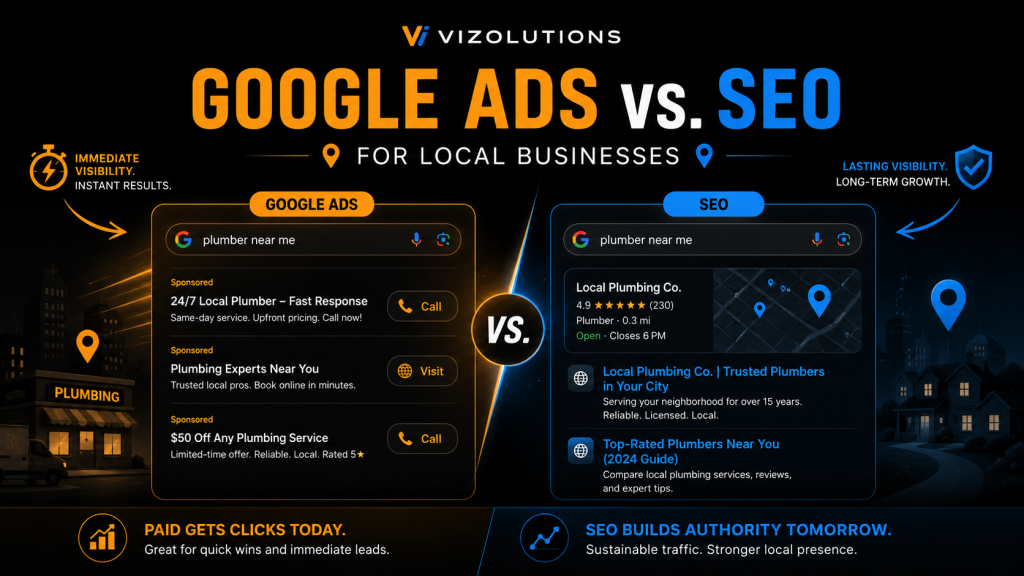
For local businesses, Google Ads and SEO solve different problems. Google Ads is best when you need immediate visibility, fast lead flow, or tighter control over targeting, while SEO is better for building durable organic visibility that keeps producing over time. The strongest local strategy often uses both, with ads driving short-term demand while SEO builds long-term authority. Google’s own guidance says PPC helps you reach customers more immediately, while SEO is the better long-term play for strengthening online presence.
If you run a local business, you have probably asked some version of this question before:
Should I put money into Google Ads, invest in SEO, or try to do both without lighting my budget on fire?
It is a fair question, and the answer is not the lazy one. There is no universal winner because Google Ads and SEO do different jobs. Our live service pages make that distinction pretty clearly: Google Ads are positioned around fast traffic and immediate visibility, while SEO is framed as long-term visibility built through strategy, content, and authority.
What Google Ads is best at
Google Ads is the tool you use when speed matters.
If you need leads this month, need to support a new service launch, want fast testing on messaging and keywords, or are trying to show up immediately for high-intent searches in your area, ads are the answer. Google’s own PPC vs. SEO guidance says PPC helps businesses reach customers more immediately and lets advertisers customize campaigns on the fly, while SEO takes more time to get right.
That makes Google Ads especially useful for local businesses like:
- home service companies that need calls now
- law firms competing for urgent searches
- med spas promoting a specific offer
- clinics launching a new service
- businesses entering a new city or neighborhood
Ads also give you something SEO cannot give you as quickly: feedback. You can see which searches convert, which offers resonate, which service pages pull their weight, and which geographies produce better leads. That is useful whether you keep scaling ads or use the data to sharpen your broader marketing.
What SEO is best at
SEO is the slower play, but its results compound over time.
A strong local SEO strategy helps your business show up organically when people search for the services you provide in the areas you serve. It also strengthens your Google Business Profile, your location relevance, your site architecture, and the trust signals that influence local visibility over time. Google’s SEO starter guidance says changes can take weeks or even months to show full impact in search, which is exactly why SEO is a long-game channel. Google’s local ranking help page also says local visibility is driven mainly by relevance, distance, and prominence.
That makes SEO especially valuable when:
- you want to reduce dependency on paid traffic
- your business needs steady long-term lead flow
- you want to rank in multiple service areas
- your customers research before they call
- you want the website to become an actual asset instead of a brochure
SEO is not just about ranking for one phrase and calling it a day. It is about building a more complete digital footprint that tells search engines and customers what you do, where you do it, and why you are worth trusting.
When Google Ads wins
There are very real situations where Google Ads is the better first move.
If your business is brand new, your website has little authority, or you need leads immediately, waiting around for SEO to mature is not always practical. Our campaigns can generate leads within hours, while SEO typically takes months. That is a huge difference when the goal is immediate demand.
A few examples:
- a plumber trying to capture emergency calls next week
- a family law firm launching a new office in a second market
- a med spa promoting a seasonal offer
- a contractor trying to stay booked through a slower season
In those cases, ads can get you on the board fast.
When SEO wins
There are many situations where SEO is the smarter primary investment.
If your local business wants to build durable visibility, strengthen non-paid lead flow, and avoid paying for every single click forever, SEO becomes increasingly valuable. We lean into that exact idea, describing SEO as long-term visibility that pays dividends over time and calling out content, on-page optimization, local profile work, and AI readiness as part of the playbook.
A few examples:
- a landscape design firm targeting high-value neighborhoods over time
- a specialty clinic educating customers before conversion
- a law firm building authority around specific practice areas
- a service company expanding organic visibility across multiple cities
If the business can afford to build patiently, SEO often delivers a stronger long-term cost structure and better defensive positioning.
When using both is the smartest move
This is usually where we like to land.
The most effective local strategy is often not Google Ads or SEO. It is Google Ads and SEO, used together with some actual thought behind the combination.
Ads give you speed, testing, and controlled visibility. SEO builds authority, trust, and long-term discovery. Together, they let you capture demand now while building the kind of visibility that gets cheaper and stronger over time.
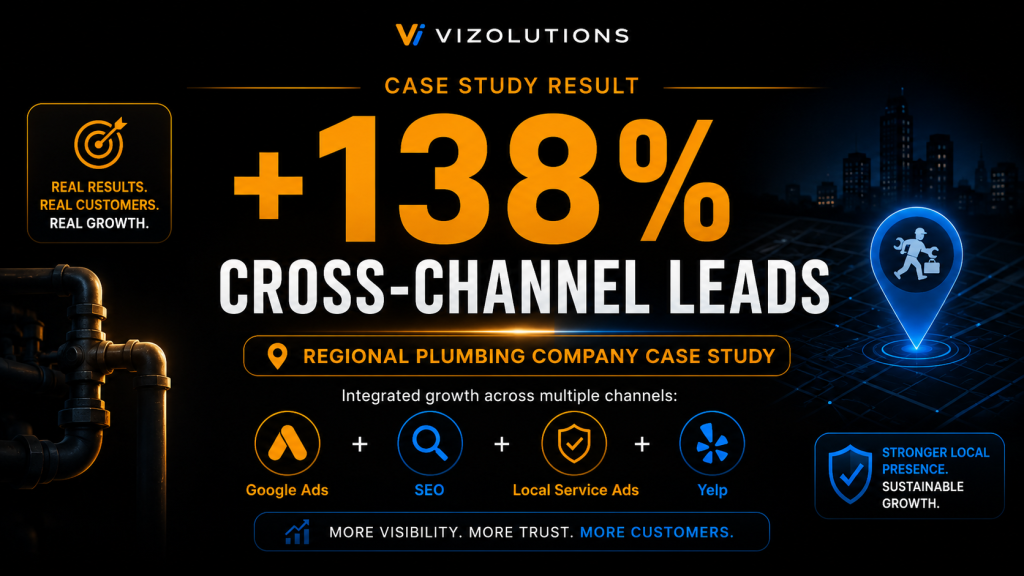
That combined approach is also reflected in a very relevant local-business example. In the Regional Plumbing Company case study, Vizolutions helped a San Diego plumbing company reduce dependence on a single lead source by scaling Yelp, launching Google Ads and Local Service Ads, and strengthening SEO and content. The result was +138% cross-channel leads, along with a more balanced and scalable pipeline.
That is exactly how we think about the mix.
How Vizolutions approaches the combination
We do not treat Google Ads and SEO like two random services sitting in different boxes.
We look at what the business actually needs.
If the problem is speed, ads usually deserve a bigger early role. If the problem is weak organic visibility, poor content coverage, or overdependence on paid channels, SEO has to do more lifting. If the problem is bigger than one channel, which it usually is, then the answer is a coordinated plan where:
- ads capture immediate high-intent demand
- SEO builds long-term rankings and local relevance
- service pages and content improve conversion quality
- local profiles support trust and visibility
- the data from paid search informs smarter organic strategy
That is also why this conversation overlaps naturally with AI Optimization. The more your site is structured clearly, the more useful it becomes not just for Google rankings, but for AI-driven discovery too.
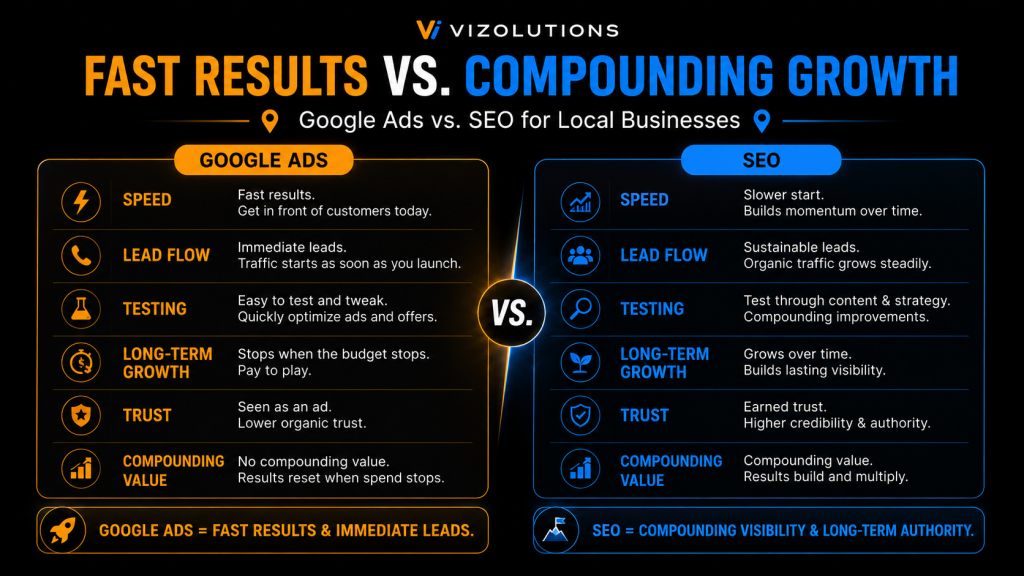
So which one should a local business choose?
If you need leads now, start with Google Ads.
If you want to build a durable lead engine, invest in SEO.
If you want both short-term momentum and long-term growth, do both and make them work together instead of competing for attention in your budget.
That is the real answer. Not flashy, but true.
Trying to figure out whether your business needs Google Ads, or a smarter mix of both? Explore our services, check out our case studies, or contact Vizolutions to talk strategy with us.
FAQs
Not inherently. Google Ads is better for immediate visibility and fast testing, while SEO is better for long-term organic growth and stronger non-paid discovery. The right choice depends on your timeline, competition, and goals.
Often yes. Google Ads can drive short-term demand while SEO builds long-term authority, local relevance, and lower-cost organic traffic over time. Vizolutions explicitly positions the two as complementary services.
Google says some SEO changes may take a few hours, but others can take several months, and it often makes sense to wait a few weeks before evaluating impact.