
Search has changed, but not in the way most people think.
The biggest shift is not that AI replaced SEO. It is that AI made average content easier to ignore.
If a machine can summarize the same basic answer from twenty lookalike blog posts, your content has a new problem. It is no longer competing just on relevance. It is competing on whether it is worth citing at all. That is exactly why AI Optimization belongs in the same conversation as SEO. Vizolutions already frames AI optimization around structured data, entity signals, and showing up in AI-generated responses, while the SEO page makes the case that strong search visibility still starts with useful content, solid structure, and authority.
AI search did not kill SEO. It made lazy SEO weaker.
A lot of people want this to be a dramatic either-or.
Either AI changes everything, or it changes nothing. Either classic SEO is dead, or AEO/GEO is some overhyped side quest.
The truth is less dramatic and more useful.
Google says the same SEO best practices still apply to AI features like AI Overviews and AI Mode, and that there are no extra requirements just to appear there. It also says those systems may use query fan-out, which means one search can trigger multiple related searches across subtopics and sources before a response gets built. In plain English, that means shallow pages have a harder time holding up when the machine starts digging. Google AI features guidance
That is the opening.
AI search does not eliminate SEO. It raises the bar for what good SEO has to become.
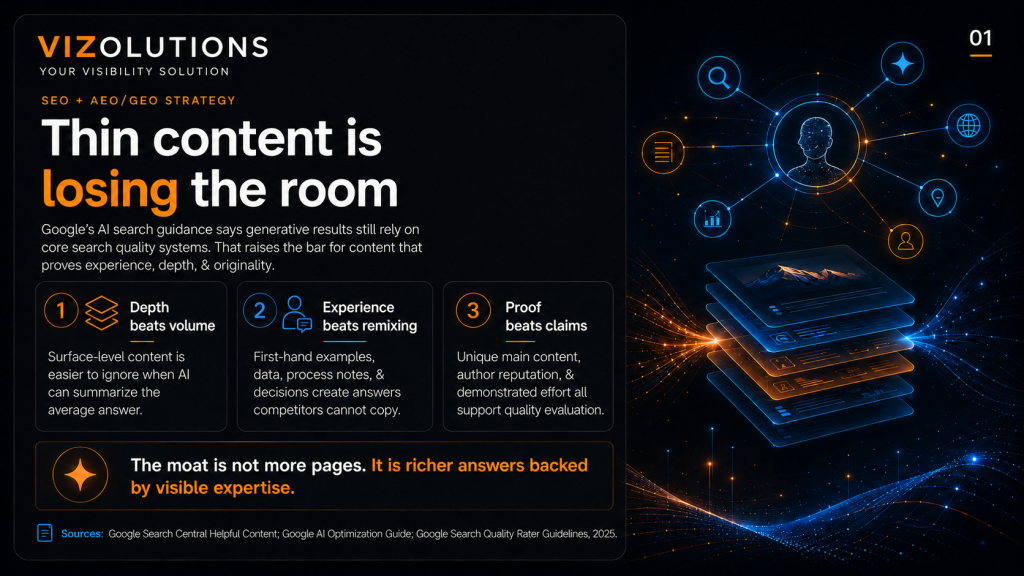
Thin content is not just boring now. It is expensive.
Thin content used to be a nuisance. Now it is a liability.
If your page just rephrases what every competitor already said, you are not giving search engines or AI systems much reason to treat it as the best answer. AI can already summarize the obvious. It does not need another 700-word remix of the same advice wearing slightly different shoes.
Google’s newer generative AI guidance leans hard into this. It says unique, compelling, useful, non-commodity content matters more than gimmicks, and specifically warns against just recycling what others have already said or what a generative AI tool could easily produce. Google’s generative AI search guide
That means content depth matters more now, not less.
The pages with a better shot at winning are the pages that bring actual perspective:
- firsthand examples
- real client scenarios
- internal frameworks
- expert judgment
- practical tradeoffs
- answers to the follow-up questions people ask once the basic definition is out of the way
That is the difference between content that fills space and content that earns visibility.
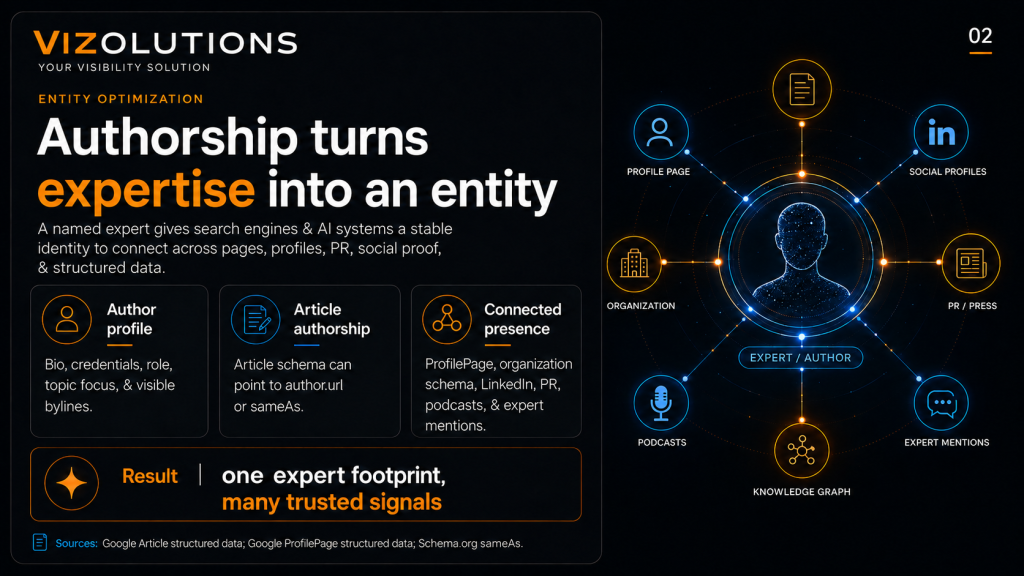
Expert authorship turns expertise into a signal
A strong author is more than a byline slapped on at the top of a post.
For AI optimization for business, authorship can become part of your entity footprint. The same person can show up across blog posts, author bios, LinkedIn, interviews, case studies, videos, podcast appearances, and structured data. The more consistent that footprint becomes, the easier it is for systems to connect the dots between the expert, the company, the topic, and the answer.
Google’s helpful content guidance is pretty direct here. It tells creators to evaluate content through “Who, How, and Why,” and says it is helpful when it is clear who created the content, when bylines lead to more information about the author, and when accurate authorship information is included where readers would expect it. Google also says its systems use signals that align with experience, expertise, authoritativeness, and trustworthiness, or E-E-A-T. Google helpful content guidance
That is not just a writing standard. It is a visibility standard.
And it fits perfectly with the point we already made in AI & SEO Still Come Back to Trust. If AI is rewarding the sources that look the most legitimate, then visible authorship is not fluff. It is part of the trust architecture.
Structured data should clarify the expert, not pretend to create one
This is where a lot of people get weird.
Schema is useful, but it is not fairy dust.
Google’s Article structured data guidance says author.url should point to a page that uniquely identifies the author, such as a bio page or social page, and says Google can understand either url or sameAs when disambiguating authors. Its ProfilePage guidance also includes fields like description, identifier, image, and sameAs to help define the creator behind a profile. Google Article structured data guidance | Google ProfilePage structured data guidance
The practical takeaway is simple.
If the expert matters to the content, make that expert easy to understand:
- give them a real bio page
- keep their name and role consistent
- connect their profile to their articles
- use author schema that matches the visible page
- tie their footprint to the rest of the brand’s entity signals
Schema does not manufacture authority. It helps clarify authority you are already earning.
Deep content gives AI something worth citing
AEO/GEO is not just about answering a question. It is about becoming a source worth pulling into the answer.
That means your content needs to do more than mention the keyword and call it a day. It should explain context, compare options, address objections, answer the next logical question, and add enough original detail that it actually helps.
A weak page answers “what is AI optimization?” and stops there.
A stronger page explains what AI optimization means, how it differs from SEO, where entity optimization fits, what structured data helps clarify, why helpful content still matters, how author schema supports trust, and what businesses should prioritize first.
One page gives the machine a definition.
The other gives it a source.
That is a huge difference.
AI content is not the problem. Commodity content is.
There is nothing inherently wrong with using AI to support content production. The problem is using AI to mass-produce pages that add nothing.
Google’s generative AI guidance says AI can be useful for research and structure, but warns that creating many pages without adding value can violate its scaled content abuse policy. It also explicitly recommends focusing on content readers would actually find satisfying instead of trying to manipulate rankings with every variation of a query. Google’s generative AI search guide
That is why the best workflow is not “have AI write the article and hope nobody notices.”
The better workflow is expert-led.
AI can help organize ideas, find gaps, build structure, draft supporting sections, and speed up production. But the value still has to come from somewhere real. The process. The judgment. The examples. The point of view. The lived experience.
In other words, AI can help package the expertise.
It should not be the expertise.
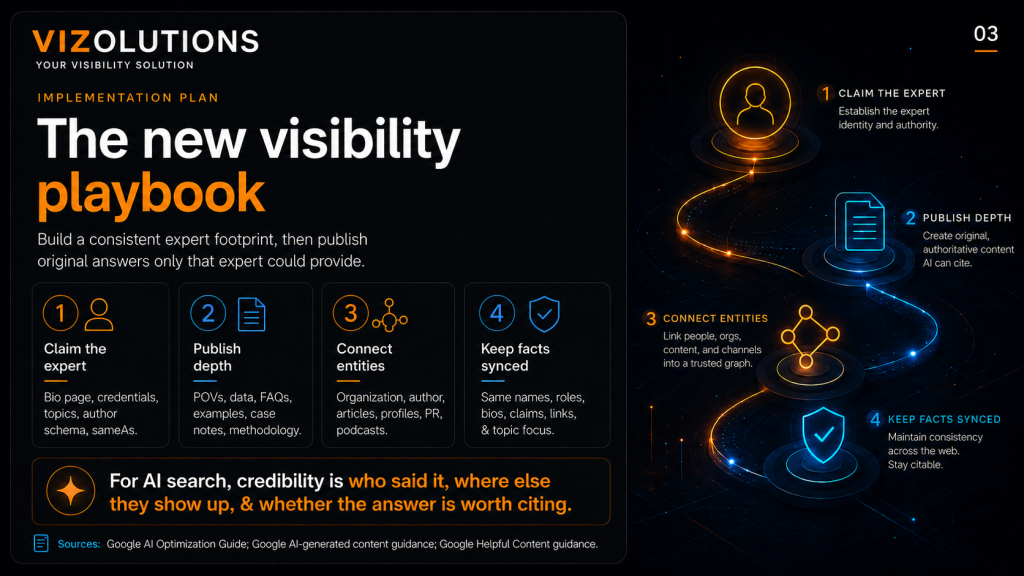
The new visibility playbook
The brands that win in SEO and AEO/GEO are probably going to have four things working together.
First, they will claim the expert.
That means visible bylines, meaningful author pages, real credentials, clear topical focus, and authors who look like actual humans instead of placeholder boxes.
Second, they will publish depth.
That means richer content, stronger explanations, real scenarios, useful FAQs, case notes, and enough substance to satisfy both the first question and the next three.
Third, they will connect entities.
That means the organization, author, article, social profiles, media mentions, interviews, and supporting pages all reinforce each other instead of floating around disconnected.
Fourth, they will keep facts synced.
Names, roles, bios, services, claims, and profile details should not contradict each other across the site, schema, and third-party references.
That is also where Marketing Case Studies help. Case studies turn expertise into visible proof, which is a lot more persuasive than another generic “top tips” post pretending to be leadership. Our case study hub already leans into exactly that idea with proof-over-promises framing and vertical-specific wins.
This is what content strategy looks like now
SEO used to get framed as rankings. AEO/GEO gets framed as AI answers.
But the underlying job is getting more unified:
Be the best answer.
Make the answer easy to understand.
Make the source easy to trust.
Make the expert easy to verify.
That is the real shift.
Most companies still treat blog content like an obligation. They publish generic educational posts, attach no meaningful author identity, add a couple of thin FAQs, and hope Google or ChatGPT decides to be charitable.
A smarter approach is to build content around the expertise already inside the company. Interview the people who know the work. Turn internal process into public explanation. Give your best thinkers visible authorship. Connect those authors to the content they create. Support the pages with structured data that matches what users can actually see. Keep the digital footprint consistent.
That is how content stops being content.
It becomes proof.
If your site has the expertise but your content does a bad job proving it, that is fixable. Explore AI Optimization, strengthen your SEO strategy, browse our case studies, or contact Vizolutions if you want help building a visibility system around the expertise you already have. Our contact page is, appropriately, very open to being bothered.
FAQs
Because it helps connect content to a real person with relevant experience, credentials, and topical authority. That gives readers more reason to trust the answer and gives search systems clearer context about who created it.
Not automatically. The bigger risk is low-value, generic, or scaled content that adds little original expertise. Google explicitly says AI can be useful, but not as an excuse to publish commodity content at scale.
AEO/GEO depends on clear, trustworthy, well-structured answers. When an expert has a consistent footprint across articles, bios, schema, and external profiles, AI systems have more context for understanding who is behind the information.