
If you have ever heard someone say “just add schema” like they were handing you a magic bean, I regret to inform you that they were overselling it.
Structured data is not wizard dust. It is not a cheat code. It is not going to take a terrible website, whisper sweet nothings to Google, and turn it into a lead machine by Friday.
What it is is one of the cleanest ways to help search engines and AI systems understand what the heck they are looking at.
Google defines structured data as a standardized format for providing information about a page and classifying its content, and says it uses structured data to understand page content and gather information about the web and the world more broadly. Google also says adding structured data can enable more engaging rich results, which may encourage people to interact more with your website.
That matters whether you are a local business trying to show up more clearly in search or a larger company trying to make your brand, locations, services, articles, authors, and organization details easier to interpret at scale.
In plain English, schema markup is how you stop making machines guess.
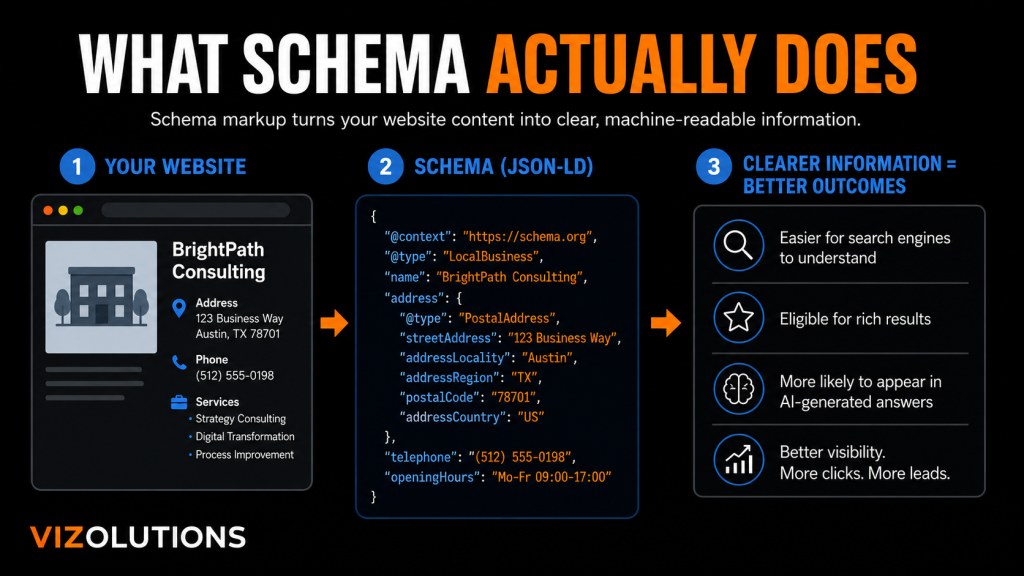
What schema markup actually is
Schema markup is structured data you add to a page, usually in JSON-LD, that labels the important parts of that page in a machine-readable way.
Instead of hoping Google infers that your business name, address, service area, author, FAQ, and logo are all connected properly, you can spell it out. Google explicitly recommends JSON-LD in general because it is easier to implement and maintain at scale.
That does not mean schema replaces good content, solid site structure, or real authority. It means that if you already have those things, schema helps you package them more clearly.
Think of it like this: your website is speaking English, but schema gives it subtitles for machines.
Why structured data matters for SEO
For traditional SEO, schema helps search engines understand your pages more precisely and can make some pages eligible for rich results. That can mean better visibility, more useful search appearances, and sometimes better click-through behavior. Google’s documentation is direct about that, and its case studies on the structured data intro page cite higher CTR, more visits, and stronger engagement on pages enhanced with structured data.
This is one reason I keep bringing clients back to structured data for SEO as part of the bigger on-page conversation. Schema is not the whole strategy, but it is one of the cleaner technical layers that helps the rest of the strategy make more sense.
It also keeps your site from feeling like a pile of disconnected facts wearing a blazer.
Why structured data matters for AEO and GEO
This is where the conversation gets more interesting.
If you care about AEO and GEO, or what I usually frame as showing up better in AI-driven discovery, schema becomes even more useful because AI systems thrive on clarity. Google’s AI features documentation says the same SEO best practices still apply to AI features like AI Overviews and AI Mode. In other words, AI search is not asking for a totally different internet. It still rewards pages that are crawlable, useful, well-structured, and easy to understand.
That is why schema for AEO/GEO is not some weird side quest. It is part of the same job: make your content easier to understand, easier to connect, and easier to trust.
Schema alone will not get you cited in AI-generated answers. But if your page is strong and your entity signals are clear, schema can help remove ambiguity. That is useful when machines are trying to figure out whether your page is about a business, a person, a service, a location, a review, an article, or all of the above.
Spoiler: “all of the above, but kind of messy” is not a great technical strategy.
Which schema matters most for small businesses
If you are a small or local business, you do not need 37 schema types because a plugin let you click every checkbox in sight. You need the ones that actually clarify who you are, what you do, and where you do it.
The big ones are usually:
LocalBusiness
This is the workhorse. Google says LocalBusiness structured data can tell it about business hours, departments, reviews in qualifying cases, and more. It also says search results may show a prominent knowledge panel with details about a matching business, and that users may see local business-related displays when searching for a type of business.
For a local business, that means your priorities often include:
- business name
- address
- phone
- URL
- opening hours
- geo coordinates
- the most specific business subtype possible, not just a vague umbrella label
If you are a plumber, dentist, law firm, med spa, or contractor, you want your schema to be specific enough that Google does not have to play detective with basic business facts.
Organization
Google says Organization structured data on the homepage can help it better understand your organization’s administrative details and disambiguate your organization in search results. It also notes that some properties can influence visual elements like logos.
This matters more than people think because a lot of small businesses have branding and entity consistency issues before they have ranking issues.
FAQ, Service, and Article-related markup
These can be useful when they match the visible content and genuinely help clarify page purpose. The key phrase there is “match the visible content.” Google says structured data on the page should describe the content of that page, and not hidden or irrelevant information.
So yes, FAQ can help when the FAQs are actually there. No, it should not become a decorative lie.
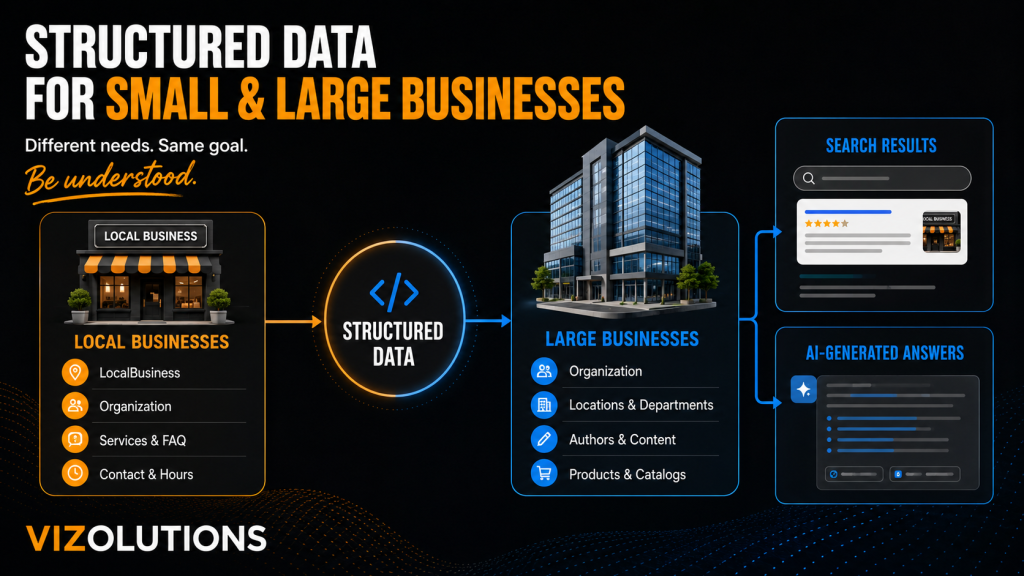
Which schema matters most for large businesses
Larger businesses have a different problem. It is usually not “does Google know I exist?” It is “does Google understand the full shape of this thing?”
That means the most useful schema often shifts toward scale, hierarchy, and disambiguation.
Organization + brand-level entity markup
This is foundational for larger companies with multiple products, teams, regions, or brand relationships. The bigger the business, the more dangerous ambiguity becomes.
Location and department markup
Google’s LocalBusiness documentation specifically supports department markup for businesses with departments that have distinct hours or phone numbers.
That matters for:
- healthcare groups
- retailers
- universities
- multi-location service businesses
- enterprises with regional offices or distinct service lines
If your site has ten locations and six service lines, but your schema acts like you are one generic blob, you are making life harder than it needs to be.
Article / ProfilePage / author-connected markup
For larger companies publishing thought leadership, this is where schema gets especially useful for tying together authorship, expertise, and content identity. Google’s structured data docs make clear that it uses structured data not only to understand pages, but also information about people, companies, and other entities included in the markup.
That is not trivial. If you want your experts, executives, or authors to look like real entities instead of anonymous content factories, structured data can help tighten those connections.
Product, review, and catalog-level markup
For larger ecommerce or catalog-heavy businesses, product schema becomes one of the biggest technical opportunities. Not because it is sexy, but because it helps machines understand products, offers, reviews, and structured attributes at scale.
Which, frankly, is more useful than a homepage hero headline that says “innovative solutions for tomorrow.”
Small business schema priorities vs. large business schema priorities
Here is the simple version.
For small businesses, schema is usually about clarity:
- who you are
- where you are
- what you do
- when you are open
- how to contact you
For large businesses, schema is usually about structure:
- how the organization is connected
- how locations, departments, products, and people fit together
- how to disambiguate multiple entities cleanly
- how to maintain consistency at scale
Small businesses often need cleaner business identity.
Large businesses often need cleaner information architecture.
Different headache. Same medicine.
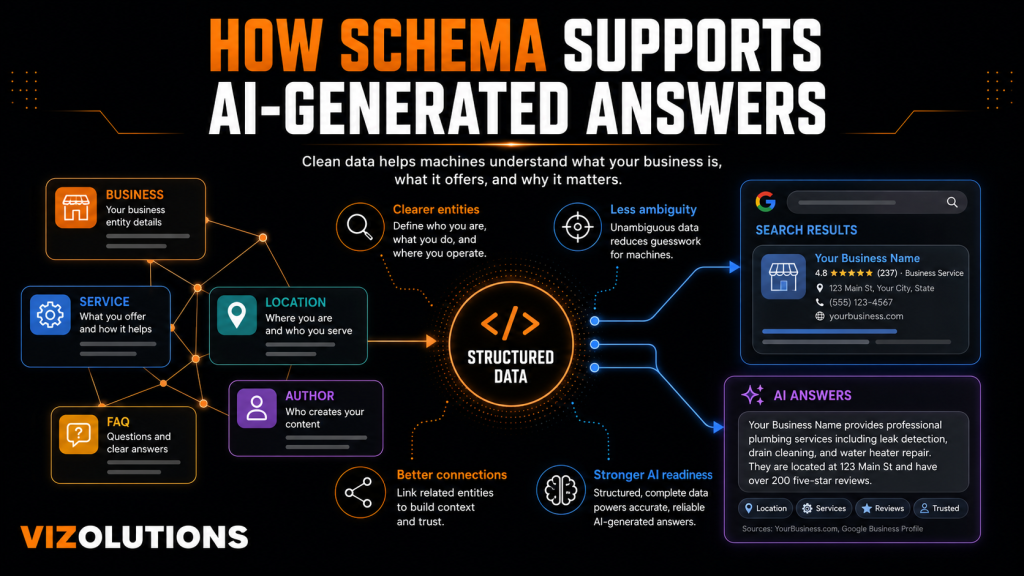
How this connects to AI-generated answers
This is the part people are circling now, usually with either too much hype or too little imagination.
AI-generated answers depend on structured understanding. They are not just scanning pretty paragraphs. They are trying to identify entities, attributes, relationships, relevance, and confidence.
Google does not say “schema is the ticket into AI Overviews.” It does say the same best practices still apply to AI features, and its structured data documentation makes clear that schema helps Google understand content and entities more explicitly.
That is enough to draw the practical conclusion:
If AI systems are trying to understand your brand, your services, your authors, your locations, and your content, then cleaner structured data is helpful because it reduces ambiguity.
Not magical. Helpful.
That distinction matters, because too many people are pitching schema like it is a UFO landing pad for ChatGPT.
What schema actually does is help your site become easier to parse, easier to connect, and easier to trust in the broader technical ecosystem that search and AI systems use to make sense of the web.
The biggest schema mistakes I see
A few repeat offenders:
1. Marking up content that is not actually visible
Google explicitly warns against adding structured data about information that is not visible to the user, even if that information is accurate.
So no, your FAQ schema should not describe a fantasy FAQ section that never appears on the page.
2. Using generic types when specific ones exist
Google recommends using the most specific LocalBusiness subtype possible. “Business” is not a personality. Be specific.
3. Letting plugins dump junk everywhere
Just because your CMS can output schema does not mean it is outputting good schema.
4. Treating schema like a substitute for strategy
If the content is weak, the structure is messy, and the entity signals are confused, schema is not going to pull off a heroic rescue mission.
It is markup, not therapy.
So, do you need schema?
If your business cares about SEO, local visibility, cleaner entity signals, and better AI-readiness, yes, you probably do.
You do not need every schema type under the sun. You do need the right markup implemented accurately, mapped to the right pages, and aligned with what users can actually see.
That is where the real value lives.
Because the goal is not to “add schema.”
The goal is to make your business easier for machines to understand and easier for real people to find, trust, and choose.
If your site is still making Google guess, that is a fixable problem. Contact Vizolutions and we can help you clean up the markup, the messaging, and the strategy without turning the whole thing into a science fair project.
FAQs
Structured data is code added to a webpage that helps search engines understand the content more clearly. It labels things like your business, services, authors, locations, and FAQs so machines do less guessing.
For most local businesses, the most important schema types are LocalBusiness, Organization, and page-level markup that supports visible content like services, FAQs, or articles. The main goal is helping search engines understand who you are, what you do, and where you do it.
Structured data helps reduce ambiguity by making your business, content, authors, and services easier for machines to interpret. It does not guarantee inclusion in AI-generated answers, but it supports the clarity that helps search engines and AI systems understand your site.
Large businesses usually benefit most from Organization markup, location or department markup, author or profile-related schema, and product or catalog schema where relevant. The main priority is helping search engines understand how your brand, locations, teams, content, and offerings connect at scale.