
Your Google Business Profile is more than a free listing with your phone number and a few photos. It helps Google understand what your business is, where you operate, which searches you are relevant for, and whether customers appear to trust you. That makes it important for local rankings, customer decisions, and the increasingly AI-driven way Google presents information about businesses.
Your Google Business Profile is probably doing more work than some people on your payroll.
It shows customers where you are, when you are open, how to contact you, what other customers think, and whether your business looks active or abandoned. It can surface before your website, beside your competitors, inside Maps, and directly within local search results.
Yet plenty of businesses still treat it like a digital refrigerator magnet.
Add the phone number. Upload one blurry photo. Forget the login. Hope Google figures out the rest.
That is not Google Business Profile optimization. That is digital landscaping by neglect.
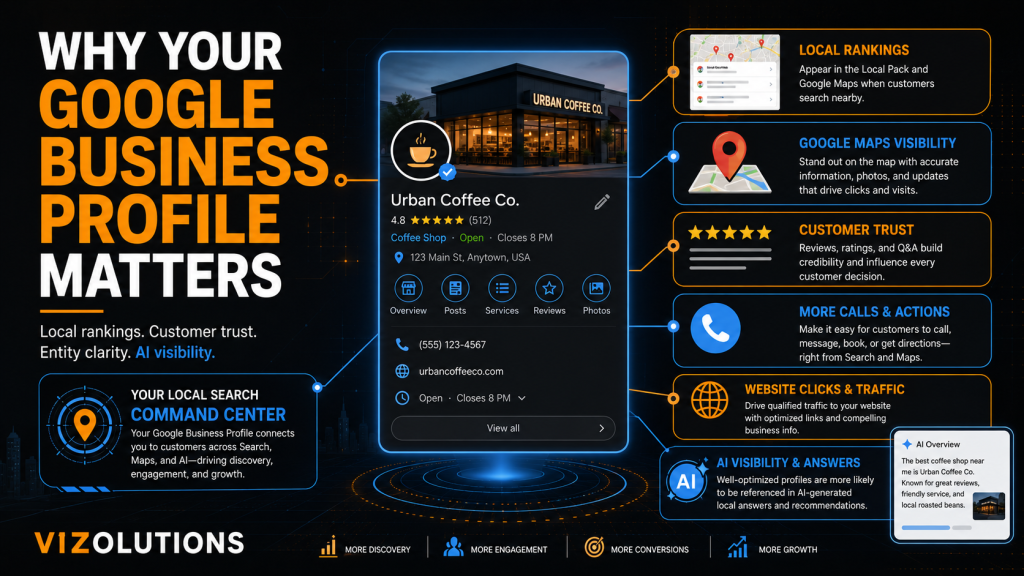
Your Google Business Profile is part of your local search foundation
When someone searches for a nearby service, Google often shows a local pack before the traditional organic results. Those prominent map listings can absorb a huge amount of attention because they answer the immediate questions:
Who is nearby?
Who is open?
Who looks credible?
Who can solve this problem?
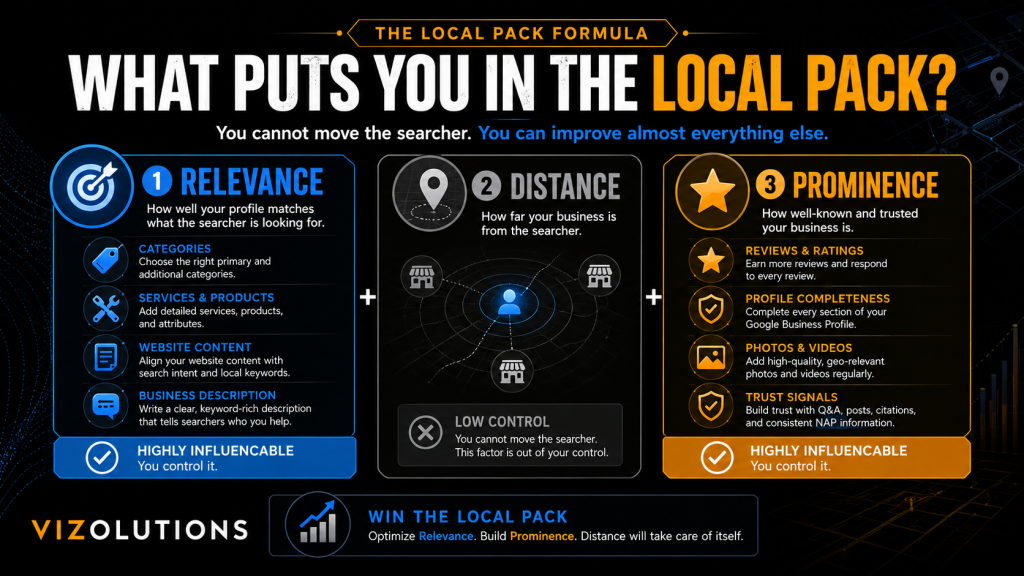
Google says local results are primarily determined by relevance, distance, and prominence. It also says complete and accurate business information makes a profile more likely to appear for relevant local searches. Google’s local ranking guidance.
You cannot control how far you are from the searcher. Unless your marketing plan involves physically relocating the building every time somebody searches, distance is mostly off the table.
You can influence relevance and prominence.
That is where your profile, website, reviews, categories, services, photos, and broader local SEO strategy begin working together.
Your profile tells Google what you do. Your website provides depth and supporting context. Reviews provide outside validation. Consistent business information helps connect the whole thing.
When those signals agree, Google has a clearer picture of your business.
When they contradict one another, you are making Google assemble IKEA furniture without the instruction booklet.
Your categories determine which searches make sense for your business
Your primary category is one of the most important choices on your profile.
It tells Google what kind of business you fundamentally are. A secondary category can provide additional context, but it should reflect a real part of the business rather than every service you have ever considered offering during a particularly ambitious Tuesday.
If you operate a plumbing company, your primary category should describe the company itself. Individual services such as water heater repair, drain cleaning, and leak detection belong in the service fields and supporting website content.
Do not treat categories like keyword stuffing with dropdown menus.
The goal is not to select the most categories. The goal is to give Google the clearest possible classification of your business.
A strong category setup helps your profile align with the searches that matter. A sloppy one can leave you appearing for weak searches, missing valuable ones, or creating a blurry business identity that does not quite match anything.
Reviews influence trust before the customer ever reaches your site
Your review profile is not just a popularity score.
Reviews help customers evaluate whether your business is credible, responsive, and capable of delivering what it promises. Google also identifies review quantity and positive ratings as factors that can contribute to local prominence.
That does not mean you should launch a frantic campaign to collect 200 suspicious reviews from people with the same last name.
It means you should build a consistent, ethical review process.
Ask real customers after real work. Make the process easy. Respond to positive reviews like a human. Respond to criticism calmly and constructively, even when the reviewer appears to have written their complaint from inside a volcano.
Your responses matter because they are public evidence of how you communicate.
A thoughtful reply can reinforce trust. A defensive five-paragraph courtroom argument rarely does.
Reviews also give Google more context about the experiences associated with your business. Customers naturally mention services, locations, staff members, results, and recurring strengths. You should never script those details or reward people for including them, but authentic customer language can reinforce what your business is known for.
Business information is entity information
Your name, address, phone number, hours, service area, website, categories, and business description are not isolated form fields.
Together, they define the business as an entity.
Google builds local listings from multiple sources, including information supplied by business owners, publicly available website content, user contributions, licensed data, and Google’s own interactions with a place or business. Google also notes that local listings may contain AI-generated summaries based on sources such as place information and customer reviews. Google’s explanation of how local listing information is sourced and used.
That makes consistency important.
Your company name should match across your profile, website, social profiles, directories, and structured data. Your services should be described consistently. Your location information should not wander around the internet changing suite numbers like it is hiding from creditors.
This does not mean every description has to be copied word for word. It means the core facts should agree.
When those facts remain consistent across trusted sources, Google has an easier time connecting them to the same real-world business.
That is entity optimization in practical clothes.
Posts keep your profile from looking frozen in amber
Google Business Profile posts allow you to publish updates, offers, events, announcements, and timely information directly on your profile.
I would not pitch posts as a magic local ranking button. Anyone promising that one weekly post will launch you to the top of Maps is selling a very small bottle of snake oil.
Posts are better understood as a relevance and conversion tool.
They can show customers that your business is active. They can highlight seasonal services, limited offers, upcoming events, recent projects, or useful information that helps someone make a decision.
A roofer might post about storm inspections after severe weather. A tax firm might post an approaching filing deadline. A restaurant might promote a new menu or special event. A marketing agency might publish a blog post about Google Business Profiles, then spend several minutes admiring how gracefully it completed the circle.
The practical rule is simple: publish when you have something useful to say.
Do not post filler just to prove you have access to the button.
Photos help customers understand what they are choosing
Your photos should answer questions that written copy cannot answer as quickly.
What does the location look like?
What kind of work do you perform?
Who will arrive at the customer’s home?
What does the finished result look like?
Does this business appear active and legitimate?
Use current, clear images of your team, location, products, equipment, completed projects, and customer experience where appropriate.
Avoid relying entirely on stock photography. A stock image of an extremely clean plumber smiling beside a wrench may look polished, but it does not prove that your actual company owns a wrench.
Real images provide real context.
They also support entity consistency by visually connecting your profile to the same branding, people, vehicles, storefronts, and services shown elsewhere online.
Questions and answers can shape customer expectations
Where Q&A is available for your business category and region, it gives customers another path to learn about your services directly from the profile. Google notes that the feature is available only for select categories and regions, and that its appearance and functionality may change. Google’s Business Profile editing guidance.
That uncertainty is another reason you should not build your entire strategy around one profile feature.
Still, when questions appear, they matter.
Monitor them. Answer accurately. Keep responses concise. Correct misinformation before it becomes the unofficial version of your business policy.
Common questions may involve:
- service areas
- appointment availability
- parking
- accessibility
- emergency service
- estimates
- accepted payment methods
- product availability
The answers should match your website and real business practices. If your profile says you offer same-day service but your website says appointments require two weeks, somebody is going to have an unpleasant afternoon.
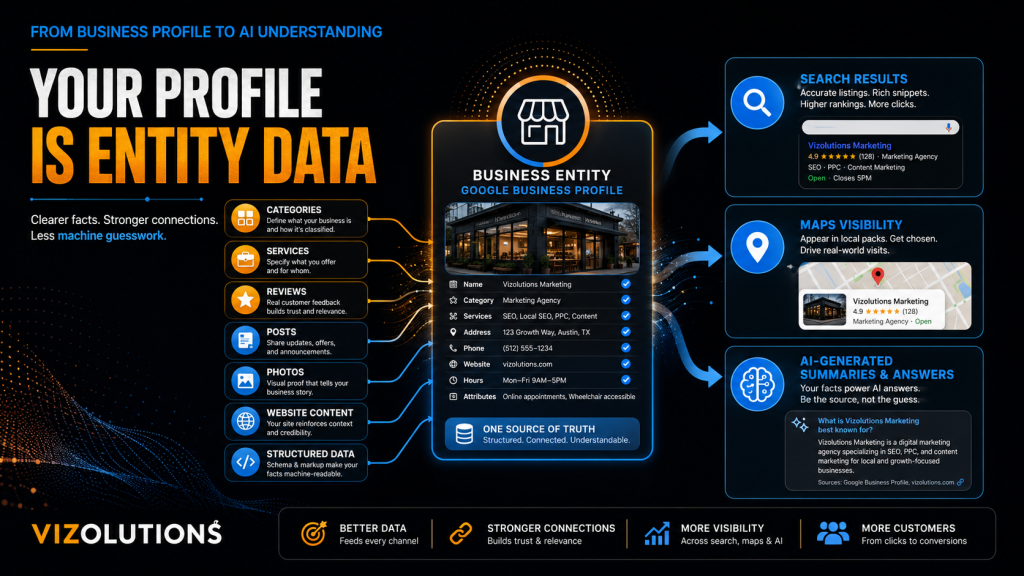
Your profile can influence how Google builds AI-driven local answers
This is where Google Business Profile optimization overlaps with AI optimization.
Google increasingly summarizes business information, reviews, common themes, and local details directly within Search and Maps. Its documentation confirms that local listings can include AI-generated summaries compiled from one or more information sources.
That does not mean completing your profile guarantees a citation in every AI answer.
It means accurate profile information provides Google with clearer, fresher, and more consistent facts about the business. Combined with your website, reviews, structured data, and third-party references, those facts contribute to the entity Google is trying to understand.
This is why entity optimization for AI search matters beyond adding a few schema properties and hoping a robot sends a thank-you card.
You want the major information sources about your business to agree on:
- who you are
- what you offer
- where you operate
- who you serve
- why customers trust you
- how your brand connects to relevant people, services, and locations
The clearer those relationships become, the less ambiguity machines have to resolve.
That is not a guarantee of AI visibility. It is the technical and reputational foundation that makes visibility more plausible.
What a properly optimized profile should include
At minimum, your profile should have:
- an accurate real-world business name
- the strongest relevant primary category
- carefully selected secondary categories
- complete contact information
- current regular and holiday hours
- an accurate address or service area
- a useful business description
- clearly defined services or products
- current photos
- an active review and response process
- relevant posts when you have genuine updates
- monitored questions where the feature is available
- a website that confirms and expands upon the profile information
None of those steps is especially glamorous.
That is usually how you know the advice is real.
The most valuable marketing work often looks less like a dramatic reveal and more like making sure forty small signals stop disagreeing with each other.
Common Google Business Profile mistakes
The biggest mistakes tend to come from either neglect or overenthusiasm.
Neglect looks like outdated hours, unanswered reviews, missing services, old photos, and a business description written three owners ago.
Overenthusiasm looks like stuffing keywords into the business name, selecting irrelevant categories, creating duplicate profiles, publishing filler posts, or changing major information every other week because someone watched a twelve-minute SEO video.
Both approaches create instability.
Your profile should accurately reflect the real business and remain consistent with the rest of your digital presence.
No gimmicks. No fake locations. No category confetti.
Your profile is not separate from your website
Your Google Business Profile and website should reinforce each other.
The profile provides fast, structured information for local discovery. The website provides depth, proof, service details, content, conversion paths, and broader authority.
You need both.
A beautifully optimized profile attached to a weak website can generate attention that never becomes trust. A strong website attached to a neglected profile may miss valuable local visibility before the customer ever reaches it.
The best result comes when the profile, website, reviews, content, and entity signals all describe the same credible business.
That is what makes Google Business Profile optimization more important than it first appears.
You are not just updating a listing.
You are helping Google and your customers understand exactly why your business belongs in the conversation.
Your Google Business Profile should be doing more than confirming that you exist.
It should help you appear for the right local searches, earn trust before the click, reinforce your broader entity, and turn nearby demand into real opportunities.
When your profile, website, and AI visibility signals are not working together, contact Vizolutions. We will help you clean up the contradictions, strengthen the right signals, and make your business much easier to find and choose.
Google Business Optimization FAQs
Google Business Profile optimization is the process of improving your business information, categories, services, photos, reviews, posts, and other profile elements so customers and Google can understand your business more clearly. It supports local search visibility, customer trust, and stronger consistency across your digital presence.
Yes. Google says complete and accurate profile information can improve your ability to appear for relevant local searches. Your profile also contributes to relevance and prominence through business details, categories, reviews, links, and other signals.
Update your profile whenever important business information changes, including hours, services, contact details, location information, or holiday availability. You can also add fresh photos and useful posts when you have genuine updates, offers, events, or seasonal information.