
Yelp advertising for lawyers can be an unusually strong lead source for consumer-facing law firms because the people searching inside Yelp are already looking for a provider, not casually researching whether they need one. In our experience, personal injury and family law campaigns have performed especially well, but the real advantage comes when strong ads, reviews, fast response, and a disciplined intake process all work together.
If you still think Yelp is mostly for finding tacos, plumbers, and the occasional furious one-star review about parking, you are missing a pretty interesting legal marketing opportunity.
Yelp has become one of the more underused advertising channels I have seen for consumer-facing law firms.
I am talking about practices where an individual knows they have a problem and needs a lawyer: personal injury, family law, estate planning, employment law, and potentially categories like criminal defense and immigration.
That distinction matters.
A Fortune 500 company looking for complex corporate counsel probably is not starting its search on Yelp.
Someone who was just injured in a car accident, is considering divorce, or needs help resolving an employment problem absolutely might.
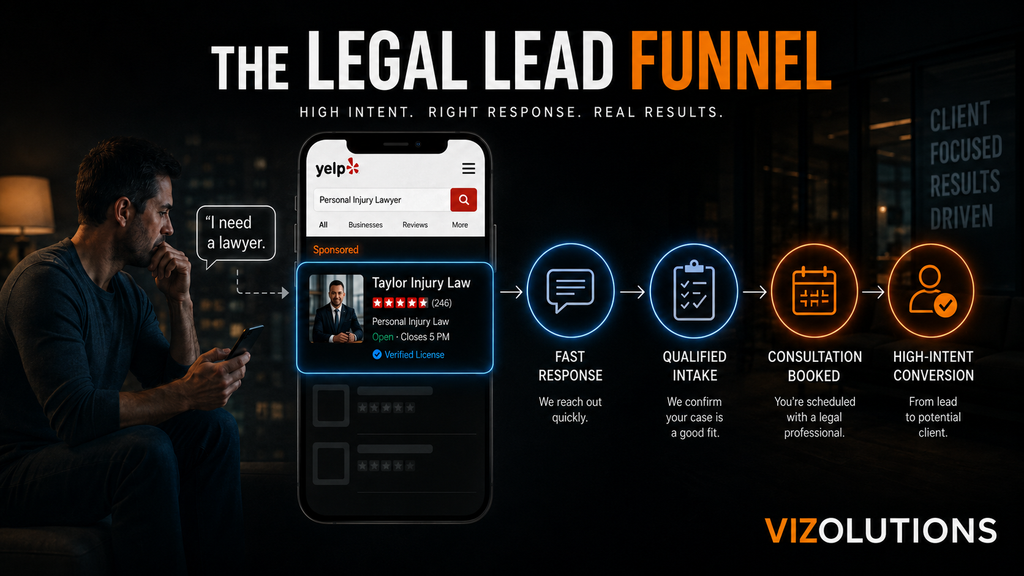
And once that person opens Yelp and types in a legal service, they are not casually browsing the internet.
They are shopping for a lawyer.
Yelp is a smaller pond with some very hungry fish
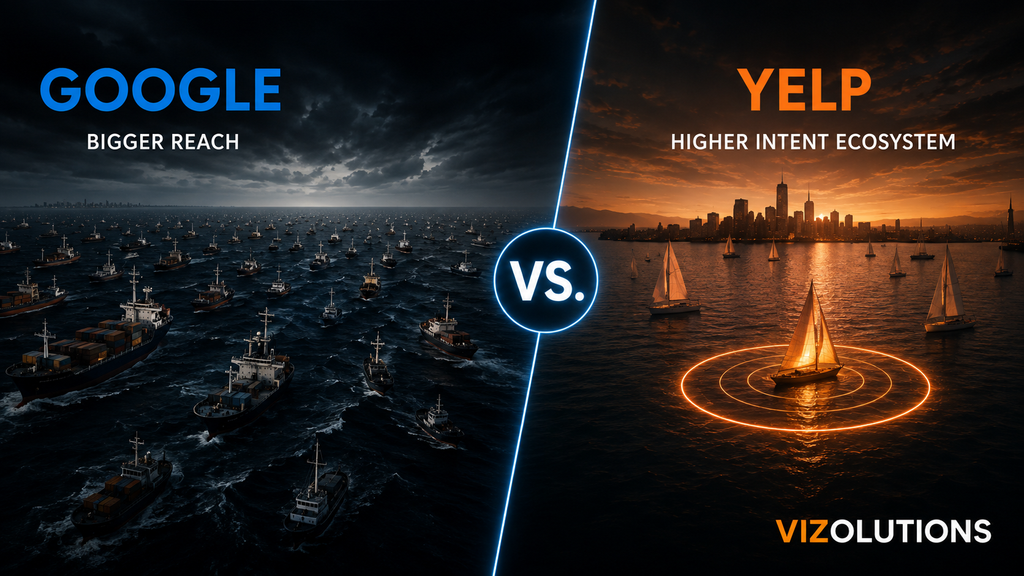
Google is enormous.
That is obviously useful, but it also means every lawyer, directory, lead-generation company, aggregator, and agency with a credit card is competing in the same ecosystem.
Legal clicks on Google can get spectacularly expensive.
Yelp is different.
The audience is smaller, but the people searching inside Yelp are typically much farther down the decision funnel. Yelp’s own law firm advertising guidance describes its audience as high intent and reports that 82% of surveyed users hired or bought from a business they found on Yelp within a week, while 57% contacted a business they researched within a day. Yelp’s law firm advertising guide
That is the attraction.
You are not throwing a giant net across the internet hoping somebody needs a lawyer.
You are entering an ecosystem where the person has already raised their hand and said, “I need this service.”
Then the decision gets fairly human.
Who looks credible?
Who has great reviews?
Who handles the kind of problem I have?
Who responds first?
That is where Yelp advertising for law firms starts getting interesting.
Which legal practices work best on Yelp?
I want to be careful here because one of my biggest pet peeves in marketing is somebody having two good campaigns and immediately announcing they have discovered a universal law of the internet.
We have not.
I can tell you what we have actually seen.
Our strongest legal Yelp campaigns so far have been personal injury and family law. In the campaigns we have managed, both categories have performed considerably better on Yelp than they did on Google from a cost-per-click and cost-per-lead perspective.
We have also seen success in employment law.
Criminal defense and immigration are categories I think make logical sense for Yelp because they share the same consumer-facing, high-intent characteristics, but I do not have enough firsthand campaign data yet to tell you they will perform the same way.
That is an important distinction.
A good strategy starts with what you know, tests what you believe, and adapts when reality decides your theory was adorable.
Why personal injury and family law fit Yelp particularly well
Both categories tend to start with a serious personal problem.
You were injured.
Your marriage is falling apart.
You are worried about custody.
Something happened at work and you think your rights were violated.
These are not searches people make for entertainment.
The prospect already has the need. Your job is to make it easy for them to decide that your firm is the one they should contact.
That makes reviews enormously important.
When someone is evaluating a family lawyer or personal injury attorney, they do not just want a list of credentials. They want reassurance from people who have already trusted you with something significant.
Your Yelp profile creates a compact decision environment where a prospect can see your practice areas, reviews, rating, photos, services, and contact options without bouncing through twelve tabs.
Then advertising can put that profile at the top of the relevant results.
That combination of social proof + intent + visibility is why I think Yelp deserves considerably more attention from B2C law firms.
Do not run ads into a mediocre profile
If your Yelp profile looks neglected, spending money to send more people to it is not really a strategy. It is amplification of the problem. Before you increase ad spend, make sure the profile earns the click.
Your categories should accurately represent the practice areas you want.
Your services should be specific.
Your photos should look professional and current.
Your business information should be complete.
Your reviews should tell the story your marketing claims are true.
If you say you are compassionate but every review says nobody returned a phone call, congratulations, your customers have performed an unsolicited brand audit.
The ad gets you visibility. The profile helps earn the consultation.
If you are new to Yelp and don’t have any reviews yet, that’s okay too! We can help get more people interacting with your business and using your services so they will be inclined to start leaving reviews.
Response time matters a lot more than most firms think
This is one of the biggest lessons we have learned managing Yelp for law firms.
A legal lead is not patiently waiting for your intake team to finish lunch, clear the inbox, and circle back tomorrow morning.
They are usually contacting multiple options.
Yelp itself says that visible responsiveness encourages more users to message a business, and it tracks both response rate and response time. Yelp also reports that businesses responding to quote requests in less than a day see four times more requests than businesses that wait longer. Yelp response-time guidance
A day is already too slow for a lot of legal leads. That is why we have been building AI response directly into our Yelp campaigns.
Depending on the firm, we can use AI message responders during business hours, after hours, or 24/7. We can also deploy AI voice responders that are trained around the firm’s services, language, intake criteria, and voice.
The goal is not to have a robot practice law. Please do not do that.
The goal is to make sure someone who just raised their hand with a serious legal problem receives an immediate, useful response instead of a digital tumbleweed.
The AI can acknowledge the inquiry, gather basic qualification information, answer appropriate preliminary questions, and move the person toward the firm’s actual intake process.
Then your humans take over where humans should.
Yelp will tell you whether your intake team is actually as good as you think
This may be my favorite part. Almost every law firm thinks its intake team is excellent. Sometimes they are.
Sometimes we start sending them extremely high-intent leads and discover that “excellent” was more of an internal branding exercise.
One personal injury firm we worked with was convinced its conversion team was fantastic.
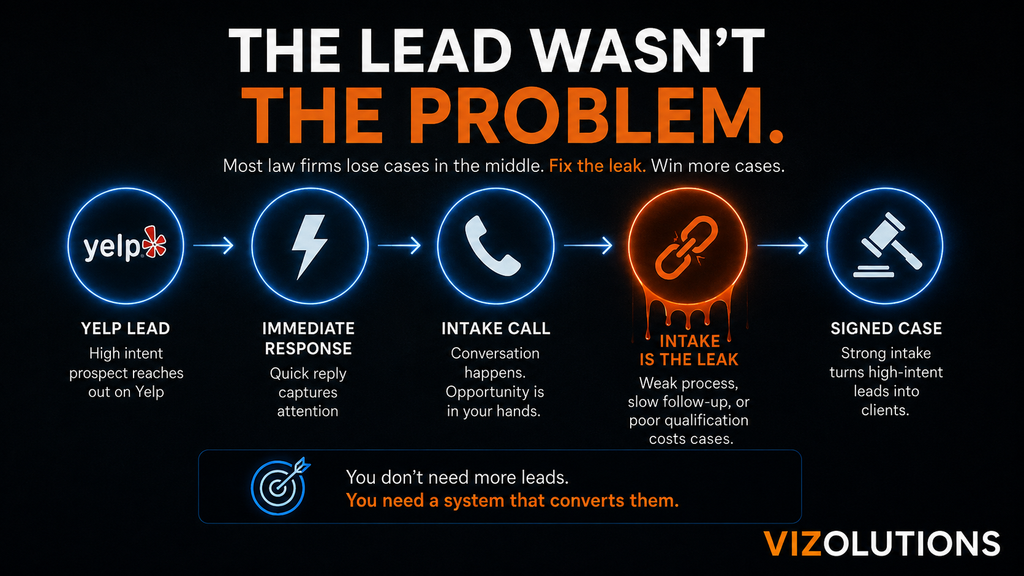
We were delivering legitimate, high-intent Yelp inquiries, and because the calls were tracked, we could listen to what happened next. Some of these should have been slam dunks.
They were not converting.
At that point, you can stop blaming the advertising. The lead was good. The person needed a lawyer. They reached out. The conversation happened. The ball hit the intake team’s hands and bounced directly into the parking lot.
Once the firm heard the calls themselves, they changed their conversion team.
Conversions jumped.
That is one of the reasons I like Yelp so much as a legal lead channel. The ecosystem can make attribution cleaner and expose exactly where the lead-to-client process is breaking.
Marketing cannot fix every sales problem.
But good marketing data can make the sales problem extremely difficult to hide.
Your Yelp campaign should plug into your intake system
This is where legal campaigns are fundamentally different from home services.
A plumber may already have ServiceTitan or another standardized booking system doing most of the operational heavy lifting.
Law firms are rarely that uniform.
Every firm seems to have its own combination of intake staff, CRM, call routing, consultation rules, qualification criteria, calendars, practice-management software, and organizational habits that somebody named Linda understands perfectly but nobody has ever written down.
That means your Yelp campaign has to fit the firm.
You cannot simply drop leads into a generic funnel and call the job finished.
For one firm, success might mean routing every qualified inquiry directly to an intake specialist.
For another, it might mean AI qualification first, then scheduling.
Another firm may need different flows depending on practice area, geography, case value, urgency, or whether the lead comes in after hours. That is what verticalization means to me. Not “we run Yelp ads for lawyers.”
It means you understand what happens after the click well enough to build the campaign around how that particular law firm actually converts business.
That is why the Best in Verticalization award mattered to us
Vizolutions won Yelp’s Best in Verticalization for Legal Services, and that recognition meant more to me than a generic agency award because it reflected the work we had actually been doing.
We grew our legal business substantially by treating law firms differently from plumbers, exterminators, healthcare companies, and every other vertical. That sounds obvious. It apparently is not.
Legal leads carry higher stakes. The conversation is more sensitive. Qualification is more nuanced. Intake has more variables. Your conversion process matters enormously because the value of a signed legal matter can be substantial.
We learned to look at the whole picture.
Campaign. Profile. Reviews. Response speed. Qualification. Intake. Call quality.
Conversion.
If the ads are working but the intake team is dropping leads, we say so.
That conversation is not always delightful on day one.
It becomes much more delightful when signed cases start increasing.
To date, the law-firm Yelp campaigns we have managed have all produced positive outcomes once the entire system was working properly. I am not turning that into some ridiculous universal guarantee because that would violate basically everything I believe about marketing.
It does, however, make me pretty confident that this channel deserves more attention from B2C law firms.
Yelp Ads are not just about being at the top
Paid placement obviously matters.
Yelp Ads can put your firm in sponsored positions above relevant results and on competing business pages. Yelp also gives advertisers targeting and campaign controls that help narrow where the budget goes.
But visibility alone is not the strategy. You need to ask:
Are you targeting the right legal services?
Are those services profitable?
Is the geography realistic?
Does your profile support the ad?
Do the reviews reinforce the practice area?
Does someone respond immediately?
Can your intake team recognize a good lead?
Can they convert it?
Can you track what happened?
If the answer to three of those questions is “sort of,” increasing the budget is not necessarily the first move.
More gasoline does not fix an engine problem.
Law firms also have an advertising rulebook
There is one more distinction between advertising plumbing and advertising legal services.
Lawyers have professional-conduct obligations.
The ABA’s Model Rule 7.2 permits lawyers to communicate information about their services through media, including paid advertising, while placing restrictions around recommendations, specialist claims, and identifying the lawyer or firm responsible for the communication. Your state’s rules can differ or be more restrictive, so your Yelp advertising and automated responses need to stay aligned with the rules governing your jurisdiction. ABA Model Rule 7.2
That matters especially when you introduce AI.
Your autoresponder should help with intake.
It should not promise legal outcomes, create misleading claims, or wander into giving individualized legal advice because somebody trained it with the enthusiasm of a golden retriever.
Good automation needs guardrails. The human lawyer remains the lawyer.
Yelp should complement your broader law firm marketing
I do not believe in single-channel religion.
If somebody tells you Yelp is the only marketing a law firm will ever need, I would be skeptical.
I would say the same thing about Google Ads.
And SEO.
And social.
The strongest law firm marketing usually comes from channels doing different jobs.
Google can give you enormous reach.
SEO can build compounding organic visibility and authority.
Yelp can capture a smaller but extremely high-intent audience that many firms are still ignoring.
Reviews reinforce trust across all of them.
Strong intake converts what marketing creates.
That is the holistic approach.
If you want an example of what broader legal visibility can look like, our multi-practice law firm marketing case study shows what happens when you stop treating individual channels as isolated projects and start building an actual business-development system.
Should your law firm advertise on Yelp?
If you operate a B2C practice, I think Yelp deserves a serious look.
Especially if you are in:
- personal injury
- family law
- estate planning
- employment law
- criminal defense
- immigration
- other consumer-facing legal categories where someone is actively searching for help
That does not mean you blindly dump money into the platform.
Start with the profile.
Understand the market.
Test the categories.
Track the leads.
Respond fast.
Listen to the calls.
Measure intake.
Fix what breaks.
Then scale what works.
That process is less exciting than somebody telling you they discovered the secret lawyer-marketing hack. It also has the advantage of being real.
If your firm is paying enormous prices to fight every lawyer in town on Google while completely ignoring a high-intent marketplace with fewer legal advertisers, it might be worth seeing what the numbers look like.
And if you already tried Yelp and decided it “didn’t work,” I would be equally interested in seeing what happened after the lead arrived.
Sometimes the campaign needs fixing. Sometimes the profile needs fixing. Sometimes your intake team is about to have an uncomfortable meeting.
All three are solvable.
If you want someone who understands how those pieces fit together, talk to Vizolutions. We will open the hood, look at the whole system, and tell you what we actually think.
It can work extremely well for consumer-facing law firms because Yelp users are often actively looking for a provider when they search. In our own campaigns, personal injury and family law have been the strongest-performing legal categories so far, with employment law also producing positive results.
Yelp is generally best suited to B2C legal practices where individuals actively search for representation, including personal injury, family law, estate planning, employment law, criminal defense, and immigration. The actual opportunity varies by geography, competition, reviews, and practice area, so the market should be evaluated before assuming a category will perform.
As quickly as realistically possible. Yelp says responsiveness encourages more users to message businesses, and faster responders receive more quote requests. For law firms, immediate response is especially important because prospective clients are often contacting multiple attorneys while dealing with an urgent or emotionally significant problem.