
Google stopped showing FAQ rich results in May 2026, but that does not make FAQs useless or mean you should automatically remove FAQ schema. Well-written FAQs still improve user experience and give search and AI systems clear answers to real questions. FAQ schema remains a useful machine-readable layer when it accurately represents useful content, but it is one small part of a much larger SEO and AI visibility strategy.
Google officially stopped showing FAQ rich results on May 7, 2026.
Naturally, this created two immediate schools of SEO thought:
“FAQ schema is dead. Delete everything.”
And:
“FAQ schema is now even MORE important for AI and you should put it on every available surface.”
Because apparently nuance remains illegal on the internet. The reality is considerably less dramatic.
Google removed a search feature.
It did not make questions useless. It did not make answers useless. And it did not erase FAQPage from Schema.org.
For us, the practical answer is pretty straightforward:
If an FAQ genuinely belongs on a page, keep writing it. If you are publishing the FAQ, we still think it makes sense to mark it up correctly. Just stop pretending the schema itself is going to magically rank you in Google or get you cited by ChatGPT.
That distinction matters more now than ever.
What exactly did Google remove?
On May 7, 2026, Google stopped displaying FAQ rich results in Search. Google added the deprecation notice to its documentation the following day, removed the FAQ rich-result documentation in June, and phased out the related Search Console support. Google Search documentation updates
These were the expandable question-and-answer treatments that could appear underneath a traditional organic listing.
The writing had actually been on the wall for years.
Back in 2023, Google had already restricted FAQ rich results primarily to well-known government and health websites. Google explicitly said at the time that most sites could leave their existing FAQ structured data in place even though it would no longer have a visible effect in Search.
May 2026 finished the job. The rich result disappeared.
The usefulness of the question did not.
FAQs were never valuable only because of the rich result
This is where I think people got the relationship backward. A useful FAQ is valuable because somebody actually has that question. If someone is looking at an estate planning attorney’s service page and wondering:
“What happens if I die without a will in California?”
That question is useful whether or not Google gives it a fancy dropdown. If somebody is comparing landscaping companies and asks:
“Can defensible-space landscaping still look good?”
Answering that question can help them understand the service and become more comfortable hiring you.
The FAQ itself is content. The rich result was distribution. Those are not the same thing. Removing one does not automatically destroy the other.
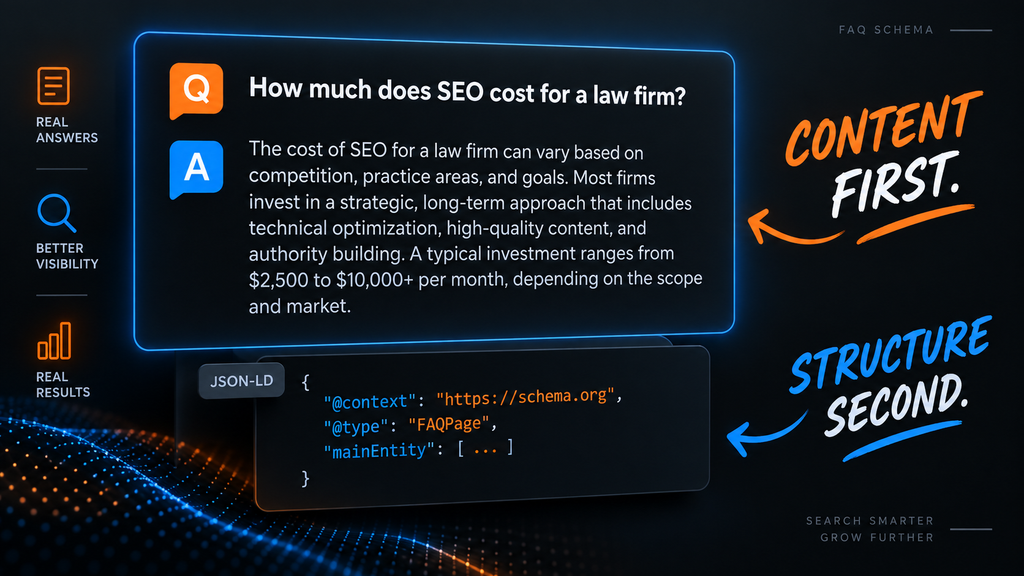
Good FAQs are built around actual intent
This is also why we do not recommend slapping FAQs onto every page like Parmesan at an Italian restaurant.
A good FAQ should answer something a real prospect is likely to ask while considering that specific service, product, practice area, or offering.
That generally makes FAQs a natural fit for important commercial pages.
A personal injury page may have completely different questions than an estate planning page.
A landscape construction page should not share five generic questions with every other service page on the site.
And I have very little interest in building one enormous /faq/ page containing everything from pricing to privacy policies to whether your office validates parking.
That is not a content strategy. That is a junk drawer.
Use FAQs selectively, where the question actually helps somebody understand the subject of the page.
Why FAQs can still be useful for AI search
This is where we need to be particularly careful not to turn a reasonable idea into another SEO fairy tale. We like the FAQ format for AI-oriented content because it naturally mirrors how people interact with AI systems.
People ask questions.
A good FAQ presents a clear, specific question followed immediately by a complete, useful answer.
That is a sensible information structure.
It can make a page easier for humans to scan, and it gives machines a clean passage of text that directly addresses a recognizable information need.
But there is a massive difference between saying:
“This is useful content structure for AI search.”
and saying:
“Add FAQ schema and ChatGPT will cite you.”
The second statement requires a confidence level nobody should have.
Google’s own 2026 guidance is remarkably blunt about this. There is no special Schema.org markup required for Google AI Overviews or AI Mode, and Google specifically warns site owners against overfocusing on structured data as an AI optimization tactic. Google’s generative AI optimization guidance
That does not mean structured data has no value. It means schema is not your golden ticket into the robot clubhouse.
So what does FAQ schema still do?
Structured data is a standardized way of giving machines explicit information about the meaning and organization of a page.
Google still describes structured data as providing explicit clues about page content and says it uses structured data to better understand information on the web. Google’s structured data documentation
That is the part we still care about.
If your page contains a visible question and answer, FAQPage, Question, and Answer markup provide a standardized machine-readable description of that content.
FAQPage also remains a valid Schema.org type today.
That does not mean every crawler, search engine, or large language model uses that markup the same way.
It does mean you are giving any system that chooses to consume structured data one less thing to infer.
And if the FAQ already exists and adding accurate markup is inexpensive, I have a hard time seeing the argument for intentionally making the page less explicit.
Schema helps reduce ambiguity, not crawl budget
There is another technical distinction worth cleaning up.
You will sometimes hear structured data discussed as a way to “save crawl budget.”
That is not really what it does.
Google defines crawl budget around the URLs its crawlers can and want to fetch and the resources required to crawl them. For most ordinary business websites, Google says crawl budget is not something owners need to spend much time worrying about anyway.
Schema does something different.
It gives machines structured information after they reach the page.
So I would describe the advantage as reducing ambiguity, not reducing crawl budget.
The machine still has to visit the restaurant.
You are just giving it a menu instead of making it inspect everybody’s plate.
Where marketers overstate FAQ schema
This is the part that gets under my skin.
FAQ schema is a small technical component in a much larger campaign.
It is not a silver bullet.
It is not a direct replacement for authority. It is not a shortcut around having credible authors. It is not a substitute for experience. And it is definitely not a secret setting that suddenly makes you rank in AI results. You can create the world’s most immaculate JSON-LD around terrible content.
Congratulations.
You now have beautifully organized terrible content. The machines may understand perfectly that it is terrible.
AI visibility starts with credibility, not markup
The part that is considerably harder than adding schema is building a site worth citing in the first place.
Who wrote the answer?
What have they actually done?
Why should somebody trust them?
Does the company have a legitimate reputation around the subject?
Are other credible sources supporting that reputation?
Is the answer specific, useful, current, and grounded in actual experience?
Those questions bring us straight back to E-E-A-T: experience, expertise, authoritativeness, and trustworthiness. FAQ schema can describe the structure. It cannot manufacture the credibility behind it.
That is why our approach to AI optimization treats structured data as one part of a broader system rather than the system itself.
You need useful content.
You need authorship.
You need entity signals.
You need topical relevance.
You need technical SEO.
You need external corroboration.
And somewhere inside that much larger machine, yes, having clean structured data is useful. Nobody should be selling you the lug nut as the entire car.
Should every page have FAQs?
No.
That is where otherwise reasonable SEO tactics go feral.
If you can identify two or three highly relevant questions that someone genuinely considering the service is likely to ask, fantastic.
Answer them thoroughly.
If nobody has a meaningful question, do not invent five because your WordPress plugin has an empty FAQ module glaring at you.
We generally favor FAQs on pages where intent is strongest: service pages, legal practice-area pages, important product or offering pages, and other core commercial content where prospective customers naturally need additional information before taking the next step.
That is also where a well-built SEO content strategy should be doing its most useful work. Not creating more content.
Creating the right content.
Should you still add FAQ schema?
Our answer is generally yes, when you already have legitimate FAQs on the page.
The logic is simple.
The FAQ benefits the human reader. The question-and-answer format creates a clear information structure. Schema can provide an additional standardized machine-readable description of that structure. There is no longer a Google FAQ rich result waiting for you. There is no guarantee of better rankings. There is no guarantee of an AI citation.
There is just a small, sensible technical optimization supporting useful content that should already exist.
That is enough.
Not every marketing tactic has to secretly be the most important thing on Earth.
Should you remove existing FAQ schema?
If it accurately represents visible FAQ content on the page, I would not rush around deleting it just because the rich result disappeared.
Google itself previously said there was no need to proactively remove unused FAQ structured data when it reduced the feature’s visibility in 2023.
The calculation changes if your implementation is broken, inaccurate, bloated, or marking up information that is not actually visible to users.
Bad structured data does not become good structured data because we are nostalgic for rich results.
Keep it clean.
Keep it accurate.
Keep it aligned with the page.
And spend most of your energy on the part people can actually read.

FAQ schema still matters. Just not nearly as much as some people want it to.
Google killing FAQ rich results was not Google announcing that questions no longer matter. It was Google removing a particular visual treatment from its search results.
The bigger strategy remains intact.
Answer real questions.
Answer them well.
Put them on the pages where those questions naturally belong. Attach those answers to credible people and businesses. Use structured data to make the information more explicit when appropriate. Then move on and work on the other 97 things that also contribute to SEO and AI visibility.
If somebody tells you FAQ schema alone is going to unlock AI search, they clearly do not understand the first thing about AI search.
If somebody tells you structured data is completely useless now because one rich-result feature disappeared, they are throwing out the toolbox because Google discontinued one screwdriver.
There is quite a lot of territory between those two opinions.
That is usually where the useful strategy lives.
If your AI optimization strategy currently consists of installing a schema plugin, adding twelve FAQs to every page, and hoping ChatGPT notices, we should probably talk.
Vizolutions builds SEO and AI optimization campaigns around the whole picture: useful content, real expertise, technical structure, entity signals, authorship, authority, and the boring-but-important pieces that help all of it work together.
Schema stays in the toolbox. We just refuse to pretend it is the entire toolbox.
Frequently Asked Questions
FAQ schema no longer makes pages eligible for Google’s FAQ rich results because Google discontinued that feature in May 2026. However, structured data can still provide explicit machine-readable information about page content. We recommend using FAQ schema when a page contains legitimate, visible FAQs rather than adding FAQs solely for markup.
There is no documented evidence that FAQ schema directly earns AI citations or improves rankings in generative search. Google specifically says no special schema is required for AI Overviews or AI Mode. Well-written FAQs may still be useful because they clearly pair real questions with complete answers, while structured data can make that content more explicit to systems that consume it.
Not necessarily. If the schema accurately represents useful FAQ content that remains visible on the page, there is little reason to remove it simply because Google discontinued FAQ rich results. Fix or remove markup that is inaccurate, outdated, unnecessary, or disconnected from the visible content.