
E-E-A-T stands for Experience, Expertise, Authoritativeness, and Trustworthiness. It is not a secret Google score or a single ranking factor. It is a useful way to think about whether your content proves that real people with real knowledge are behind it. As AI makes generic information easier than ever to produce, original experience, credible authorship, connected entities, and content that actually says something are becoming more valuable, not less.
SEO has collected enough acronyms to qualify as its own dialect.
SERP. CTR. GBP. AEO. GEO. And then there is E-E-A-T, which somehow added an extra E and expects everyone to carry on normally.
Fortunately, the idea behind it is a lot simpler than the acronym.
E-E-A-T stands for Experience, Expertise, Authoritativeness, and Trustworthiness. Google uses the framework to describe qualities associated with helpful, reliable content. Google is also very clear about two things that matter here: E-E-A-T is not one specific ranking factor, and trust is the most important part of the framework. Google’s people-first content & E-E-A-T guidance
That distinction matters because anyone telling you they know the exact formula for E-E-A-T, SEO, AEO, GEO, or whatever acronym arrives next Thursday is selling you a level of certainty the rest of us do not have.
Search changes. Algorithms change. AI systems change. Google changes its own guidance. What worked extremely well for one company can work differently for another.
There are no silver bullets here.
What you can do is build better signals.
You can prove that the content comes from real experience. You can make expertise visible. You can earn authority beyond your own website. You can give people legitimate reasons to trust what you are saying.
And, somewhat wonderfully, the great irony of the AI era is that the new North Star online may be becoming as human as possible.
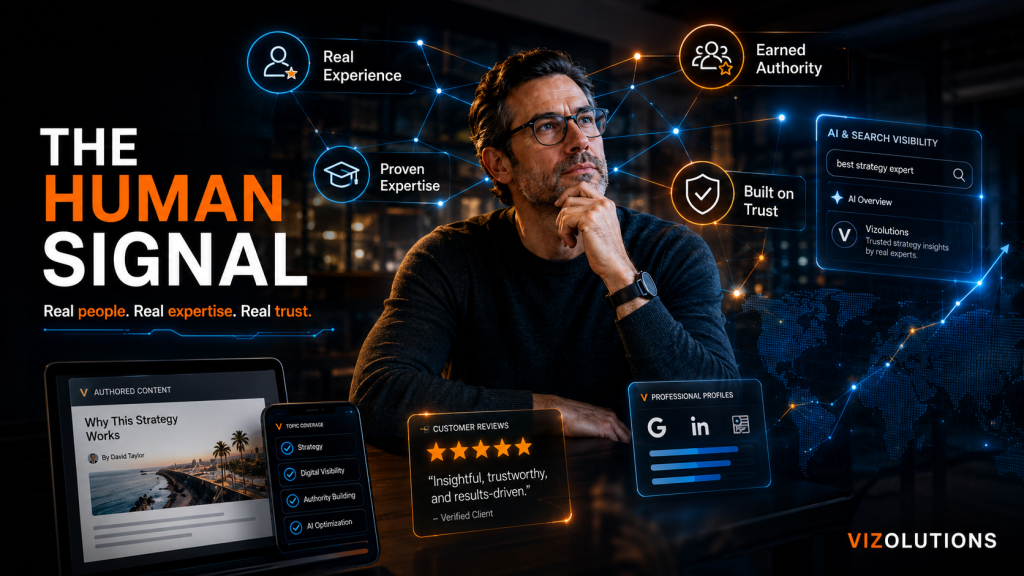
The first E is Experience
Experience answers a pretty simple question:
Have you actually done the thing you are talking about?
You can know everything academically possible about remodeling a kitchen and still learn something new the first time you discover that a 70-year-old house has apparently been held together by optimism and three different electrical codes.
Firsthand experience gives content something generic research cannot.
That can mean:
- photos from completed projects
- specific client situations
- observations from years in the field
- lessons from things that did not work
- original testing
- screenshots or demonstrations
- before-and-after examples
- processes your company actually uses
You do not need to turn every article into your memoir.
You just need to give your reader some evidence that somebody behind the article has actually been in the room.
If you are an exterminator, tell me about the termite problem you found in a specific type of Orange County home and why that property created a problem you do not normally see.
If you are a lawyer, explain a recurring issue you have actually encountered in your practice, without giving away anything confidential.
If you are an engineer, tell me why you built something the way you did and what you learned getting there.
That is useful because AI can summarize existing information incredibly well.
Your actual experience is the part it cannot simply pull out of somebody else’s article and repackage.
The second E is Expertise
Experience means you have done it.
Expertise means you understand it.
There is some overlap, but they are definitely not the same thing.
If somebody has changed one tire, they technically have experience changing tires. I am still not putting them in charge of a Formula 1 pit crew.
Expertise comes from demonstrated knowledge.
Depending on the subject, that can include:
- professional credentials
- education
- licenses
- certifications
- years of experience
- technical explanations
- accurate sourcing
- specialized methodology
- a deep body of work around a subject
How much formal expertise matters depends heavily on what you are talking about.
I do not need a Ph.D. to tell me whether a cheeseburger was good.
I would like considerably more qualification from the person explaining what medication I should take.
Google makes a similar distinction. Its systems place greater importance on strong E-E-A-T signals for topics that can significantly affect people’s health, financial stability, safety, or well-being, often called YMYL or “Your Money or Your Life” subjects.
The higher the stakes, the harder your content needs to work to demonstrate expertise.
That is why a real SEO content strategy should consider who is creating the information, what they actually know, and how you prove it.
Keywords matter.
The person behind the words matters too.
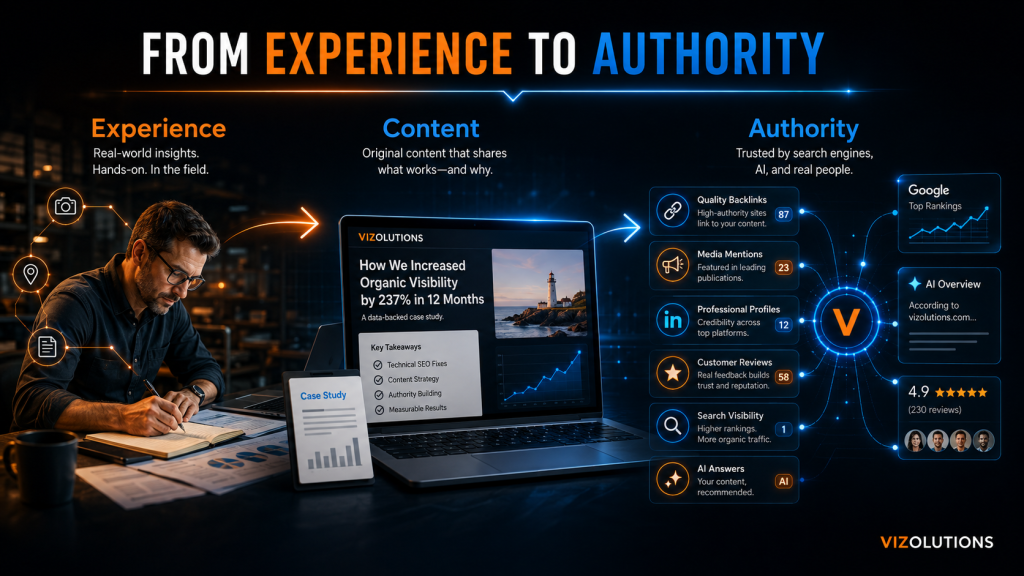
Authoritativeness is where other people enter the conversation
This one is especially important because every company is apparently the “leading provider” of whatever it sells.
You can say you are an authority.
That does not necessarily make you one.
Authority gets stronger when other credible people, organizations, publications, customers, and industry resources begin corroborating that claim.
That might include:
- reputable websites linking to you
- industry organizations referencing you
- press coverage
- interviews
- podcast appearances
- professional profiles
- speaking engagements
- customer reviews
- citations of your research
- meaningful awards
- experts referencing your work
Authority is basically reputation with receipts.
This is also where entity optimization starts making practical sense.
Say you have an author on your site.
Great.
Now that author has a detailed bio. Better.
Their bio connects to LinkedIn. Better again.
Maybe they also have a relevant Google Business Profile, Avvo profile, Houzz profile, professional association membership, licensing record, media appearance, podcast interview, conference bio, or some other legitimate industry-specific presence.
Now multiple independent sources are describing the same real human being.
One profile says who you are.
A consistent network of credible profiles helps prove it.
Is there some magical number where Google throws confetti and declares you officially authoritative?
No.
But if the people competing with you have substantially more credible signals attached to their names and businesses, I would rather build more than sit around debating whether three profiles should technically be “enough.”
Trustworthiness is the letter holding everything together
Trust is where the other three letters cash their checks.
Google explicitly describes trust as the most important part of E-E-A-T. Experience, expertise, and authoritativeness all contribute to it.
Trust can come from some remarkably unsexy things:
- clear authorship
- accurate information
- legitimate sourcing
- visible contact information
- consistent business details
- secure websites
- honest claims
- corrections when things change
- transparent policies
- clear distinction between fact and opinion
- real people attached to important advice
You can have the smartest people in your industry and still damage trust if every article is anonymous, nothing is sourced, your claims sound ridiculous, and half the information is four years out of date.
Trust is not a badge you install in the footer.
It is the cumulative result of a lot of credibility decisions.
Your marketing agency should not be inventing your expertise
This is one of the places I think businesses and marketing agencies need to be more honest with each other.
If you hire us to create content in your industry, you are not hiring us because we magically became an attorney, exterminator, landscape architect, engineer, or physician the second the contract was signed.
Expecting your marketing agency to simply invent niche expertise is a terrible model.
The strongest relationship is collaborative.
You bring the experience and expertise.
Tell us about the weird job. The difficult case. The mistake people make. The process you developed. The question customers always ask. The opinion you have after doing this for twenty years.
Our job is to extract it, structure it, write it well, optimize it, connect it to the right entities, and put it somewhere people can actually find it.
That is a completely different process than pressing the “Generate Blog” button five times and congratulating ourselves on the content calendar.
There is no shortage of AI slop online.
You do not beat it by producing AI slop faster.
You almost certainly have something unique to say
I have a hard time believing a legitimate business has nothing unique to say.
Usually, nobody has asked the right questions yet.
Maybe you solved an unusual pest problem in a particular neighborhood.
Maybe you handled a difficult business situation differently because of something you learned ten years ago.
Maybe your internal process catches a problem competitors routinely miss.
Maybe one client project taught you something that changed how you approach every project after it.
Every success gets considerably more unique once you start asking specific questions.
“Write an article about termite control” is generic.
“Why do you see this specific termite issue repeatedly in this type of Orange County construction, and what have you learned after dealing with it?” is potentially excellent content.
The expertise was there the whole time.
Somebody just had to get it out of your head.
AI-assisted content is not the problem
I use AI.
We use AI at Vizolutions.
I think AI is an incredible tool.
What I do not think it should be doing is pretending to possess expertise that nobody involved actually has.
If your competitor is publishing five AI-written articles a week, my first question is not “How do we publish six?”
My question is:
Are those five articles actually adding anything, or are they AI slop?
If you genuinely have five original, worthwhile topics every week based on real expertise, fantastic. Use AI to help organize them, research them, draft them, edit them, repurpose them, and get them published.
But if you only have one genuinely excellent thing to say this week, I would rather publish one excellent piece than five articles that could have come from any company in your industry.
AI should help package expertise.
It should not replace having expertise.
Google’s current guidance for generative AI search makes almost exactly this distinction. It recommends creating unique, valuable, non-commodity content with firsthand perspectives rather than simply recycling information already available online or producing material a generative AI model could easily recreate. Google’s generative AI search optimization guidance
That is an important shift.
As generic content becomes practically free to produce, generic content becomes a terrible differentiator.
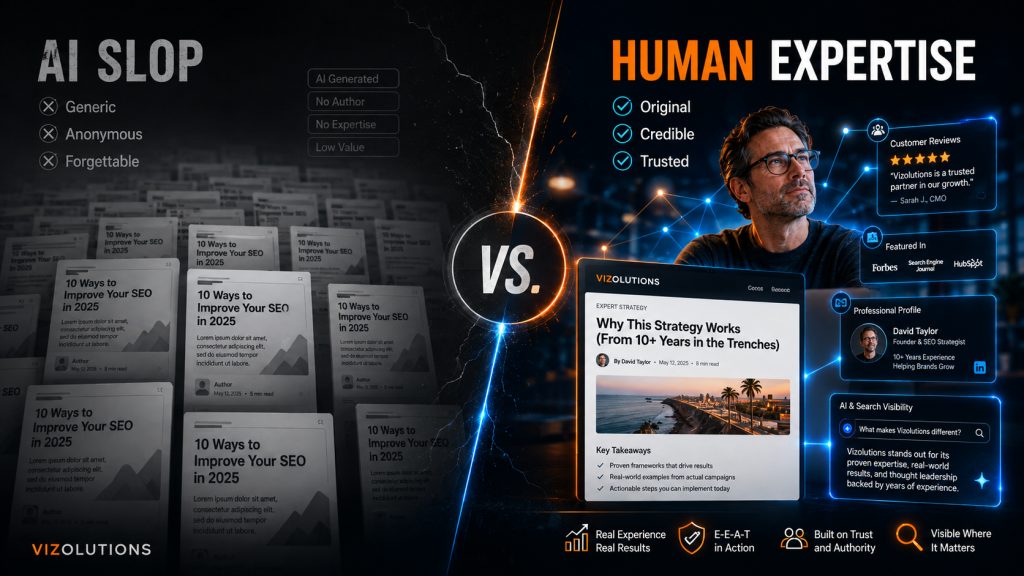
This is what E-E-A-T looks like when you actually do the work
One of my favorite recent examples is our multi-practice law firm marketing case study.
The firm already had the expertise.
They practiced personal injury, real estate, and business law. They had experienced attorneys doing sophisticated work. What they did not have was an online presence that clearly organized, demonstrated, and amplified that expertise.
They were largely invisible online and heavily dependent on time-consuming networking for new business.
So we did not manufacture expertise for them.
We exposed what was already there.
We separated the website into the practice areas that mattered most to the firm. We built stronger measurement so they could actually see what was gaining traction. We invested heavily in useful content around subjects their attorneys genuinely understood.
Personal injury was brutally competitive, and Google Ads had been an expensive place for them to spin their wheels. Instead of pretending we had a magic PPC trick nobody else knew, we leaned harder into building organic authority where the economics made more sense for their situation.
Within the first year, we helped grow their Google Business presence and website to rank #1 for “car accident lawyer” in their North County San Diego market.
But the part I actually think is more relevant to E-E-A-T is what happened with their real estate content.
We worked with the firm’s real expertise and invested in answering specific real estate questions well. Over time, that content became a dominant resource around several of those topics and began producing consistent, reliable traffic for the practice.
That is the model.
The attorneys supplied actual legal expertise.
We helped turn that expertise into structured, optimized, useful content.
Their authorship and business gave the information an identity.
Their continued work in the field gave it experience.
The content demonstrated expertise.
Search performance began reinforcing authority.
And all of those pieces together helped build trust.
There was never one magic E-E-A-T task.
There was just a lot of real work pointing in the same direction.
E-E-A-T is not four boxes you check
This is where SEO advice occasionally becomes theater.
Someone learns the acronym and immediately says:
“Quick! Add author bios!”
Yes, please add meaningful author bios.
But adding a headshot and three sentences about someone “being passionate about delivering innovative solutions” does not create authority.
The four ideas work together.
Imagine you publish an article about a complicated industry problem.
A strong version might show:
Experience: The author has personally encountered the problem.
Expertise: They clearly understand why it happens and how to address it.
Authoritativeness: Other credible sources recognize that person or business within the field.
Trustworthiness: The article is accurate, transparent, current, appropriately sourced, and connected to a real person.
Now you have something meaningful.
The goal is not to decorate your content with E-E-A-T signals.
The goal is to create content that deserves them.
Why E-E-A-T matters even more for AI visibility
This is the part I find wonderfully ironic.
We now have artificial intelligence capable of producing an effectively unlimited amount of content.
And what is becoming more valuable?
Being recognizably human.
The more boilerplate information AI can generate, the more valuable original experience becomes.
The more generic summaries appear online, the more useful specific expertise becomes.
The more anonymous content gets published, the more meaningful credible authorship becomes.
The more artificial the internet gets, the more valuable the real person behind the answer becomes.
That is why I do not see SEO, AEO, GEO, AI optimization, entity optimization, helpful content, and E-E-A-T as a pile of unrelated tactics.
They increasingly converge around the same principle:
Can a search system, AI engine, or prospective customer understand who produced this information, why they should believe it, and what makes this answer worth choosing over everything else?
We explored that idea more directly in AI & SEO Still Come Back to Trust.
And Google itself is now telling publishers that success in generative AI search still rests on foundational SEO plus unique, expert-led, non-commodity content.
So no, I do not think the answer to AI is producing more generic AI content.
I think the answer is making your real expertise considerably harder to ignore.
How do you know E-E-A-T is actually working?
There is no public E-E-A-T score.
There is no dashboard where Google tells you:
Congratulations. Authority increased 7%.
Google explicitly says E-E-A-T itself is not one specific ranking factor.
So you have to look at the signals around it.
Are your expert articles gaining visibility?
Are Google or AI-driven search experiences surfacing your content to answer relevant questions?
Are more non-branded searches finding you?
Are credible websites referencing you?
Are your authors appearing in more places?
Are people finding specific articles and then taking the next logical step toward becoming a customer?
That progression matters to me:
Useful answer → greater visibility → qualified traffic → inquiry → revenue
If someone searches something incredibly specific about their problem, finds a detailed answer from you, understands why you are qualified to answer it, and then thinks:
“Well, maybe these are the people I should call to actually fix this.”
That is exactly what good content is supposed to do.
I would not call appearing in an AI answer a conversion by itself.
But it is a pretty compelling signal that your information is being viewed as useful enough to surface.
The easiest E-E-A-T audit you can do today
Pick one of the most important pieces of content on your site and ask:
Who wrote this?
Can the reader immediately tell?
Why should anyone trust that person?
Is their relevant experience or expertise actually visible?
What does this article contribute?
Could this have been written by any competitor or generated from the first page of search results?
Can important claims be verified?
Are your strongest statements supported?
Is the information current?
Would you still confidently give somebody this advice today?
What exists outside your site to support the author’s authority?
LinkedIn? Google Business? Avvo? Houzz? Licensing information? Professional associations? Interviews? Media? Reviews? Other credible profiles?
Is the content connected to actual business outcomes?
Does the article lead somebody naturally from “this person understands my problem” toward “this company might be able to solve it”?
If some of those questions make you uncomfortable, good.
You just found the work.
So Now What?
If this article made you realize that the best expertise in your company is currently trapped inside the heads of people who never appear in your content, that is exactly the kind of problem we like solving.
You bring the experience, opinions, stories, cases, successes, failures, and weirdly specific knowledge that only your team has.
We’ll help extract it, shape it, optimize it, connect it, and make sure people can actually find it.
If that sounds considerably better than producing another pile of anonymous AI slop, talk to Vizolutions.
We’ll open the hood and show you what we’re doing.
FAQs
E-E-A-T stands for Experience, Expertise, Authoritativeness, and Trustworthiness. Google uses the concept to describe qualities associated with helpful and reliable content. E-E-A-T itself is not a single ranking factor, and Google identifies trust as the most important part of the framework.
Start by making real expertise visible. Use accurate authorship, meaningful author profiles, firsthand examples, useful case studies, credible sourcing, professional credentials where appropriate, original insight, and legitimate external references that help corroborate the expertise behind your content.
E-E-A-T is not a special AI ranking score. However, the qualities behind it align strongly with the direction of modern search. Google recommends unique, valuable, expert-led, people-first content for generative AI search, making original experience, credible authorship, and trustworthy information increasingly important.
Not by itself. Google explicitly states that E-E-A-T is not one specific ranking factor. Its ranking systems use a variety of signals that can help identify content demonstrating experience, expertise, authoritativeness, and trust.