
If you are asking how long SEO takes, you are asking the right question. In most cases, you can expect meaningful movement in roughly 3 to 6 months, while more competitive markets often take 6 to 12 months to produce stronger ranking traction. The trick is knowing what “working” actually looks like before the big visible wins show up. Google notes that SEO changes can take anywhere from hours to months to be reflected, and Vizolutions’ own SEO process is built around long-term visibility rather than quick-hit nonsense.
If you’re hoping SEO works by next Tuesday, I have bad news.
If you’re wondering whether SEO is worth doing because it takes time, I have better news.
SEO usually does take time, but that does not mean nothing is happening while you wait. It means you need to know what kind of progress to look for before the flashy stuff shows up.
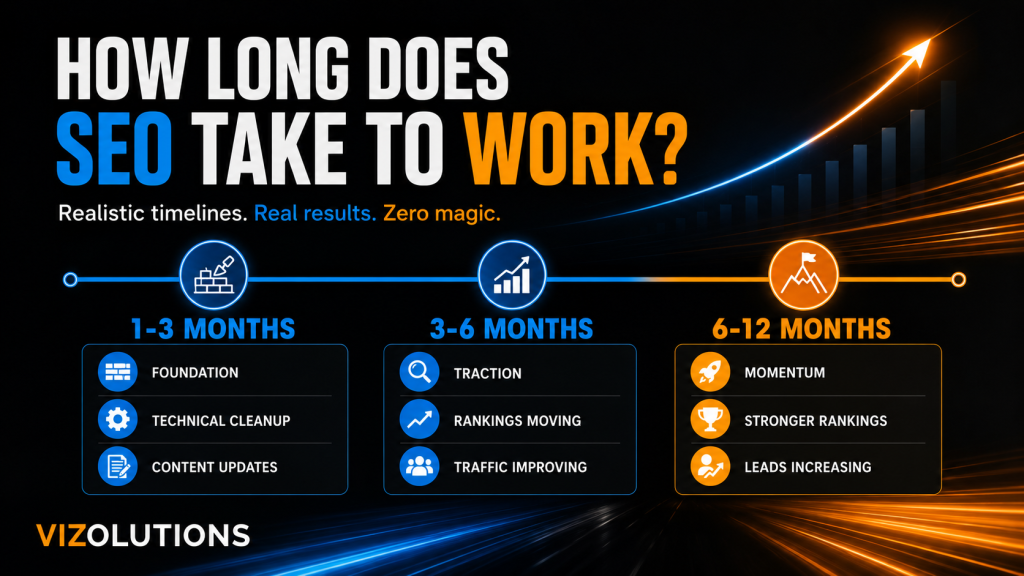
Most businesses see meaningful SEO improvement in about 3 to 6 months, and more competitive markets often take 6 to 12 months to push into stronger rankings. Google’s own documentation says some changes can show up in hours, but it can also take several months before the full effect is visible in search. That lines up pretty well with the way I talk about SEO strategy with clients. This is long-term visibility work, not microwave marketing.
Why SEO takes time in the first place
Search engines do not owe you instant trust.
That is really the whole game.
If your website has weak content, thin service pages, messy structure, no authority, and a link profile held together with duct tape and optimism, Google is not going to wake up tomorrow and decide you are the answer. You have to earn that.
That means SEO speed depends on things like:
- how competitive your market is
- how strong or weak your website is right now
- how much quality content you already have
- how well your site is structured
- how much authority your domain has
- how serious you are about actually doing the work
If you are in a lower-competition local niche, you may see traction faster. If you are in legal, high-end home services, finance, healthcare, or any market where everyone is fighting over the same valuable searches, the timeline stretches.
What to expect in months 1-3
This is the phase where impatient people start spiraling.
You may not have huge rankings yet. You may not have a flood of leads yet. That does not mean SEO is not working.
In the first 1 to 3 months, the real work usually looks like this:
- technical cleanup
- keyword research
- page structure improvements
- better internal linking
- stronger metadata
- content updates
- new service or blog content
- profile optimization
- early indexation and crawl improvements
In other words, you are building the thing that rankings sit on top of.
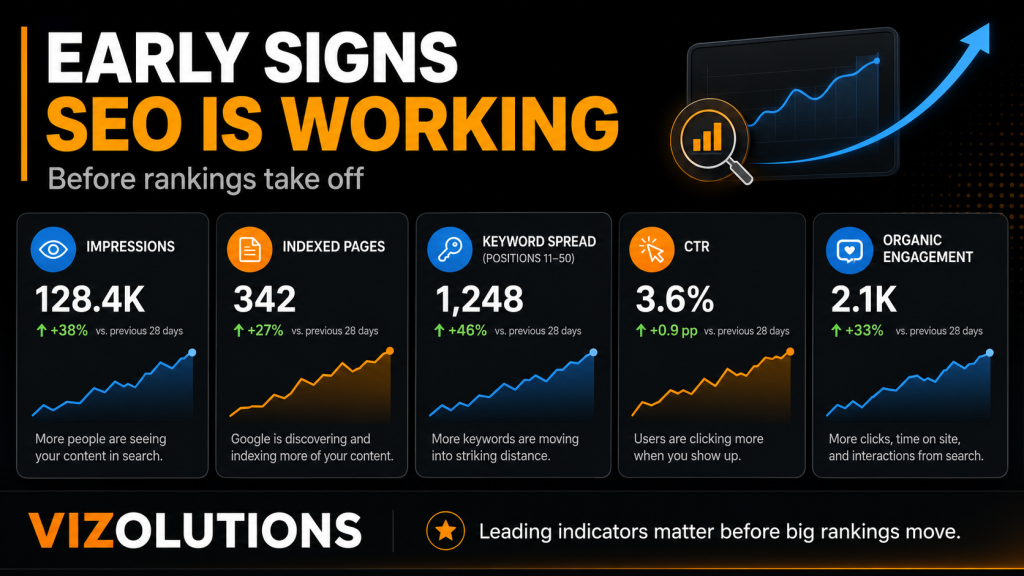
This is also when some of the first positive signals tend to show up:
- more pages getting indexed
- better impressions in Google Search Console
- more keyword spread
- improved click-through rates on updated pages
- more movement for long-tail searches
- cleaner user behavior on page
If you are only checking whether one vanity keyword jumped this week, you are grading the wrong paper.
What to expect in months 3-6
This is usually where things start feeling real.
If the work is solid, the site is in decent shape, and the market is not absurdly competitive, this is when you often start seeing more obvious movement:
- target pages climbing for relevant searches
- local visibility improving
- traffic lifting on optimized pages
- more non-branded impressions
- better-quality organic leads
- blog posts beginning to rank for supporting queries
This is also why I like pairing strong content work with on-page improvements. Rankings do not just come from fixing title tags and praying. They come from becoming a better answer across the topics your audience actually searches.
What to expect in months 6-12
This is where SEO starts getting fun.
By 6 to 12 months, you are usually no longer asking whether SEO works. You are looking at how much momentum it is building.
If the strategy is good and the execution is consistent, this is when you can start seeing:
- stronger rankings for higher-value terms
- more stable organic traffic
- better local pack visibility
- more leads from non-branded search
- more pages ranking at once
- increased authority across the site, not just one lucky page
This is also the phase where SEO starts feeling less like a cost and more like an asset. You are not paying for every click the way you do with ads. You are building a visibility engine that keeps working even when you are not stuffing quarters into it.
That is also why AI Optimization belongs in the same conversation now. Search is changing and content that is well structured, deeply useful, and easy for both Google and AI systems to understand gives you more ways to win over time. Google says the same foundational SEO best practices still apply to AI features like AI Overviews and AI Mode.
Why some industries move faster than others
Not all SEO timelines are created equal.
A local plumber in a mid-sized market does not have the same timeline as a criminal defense attorney in Los Angeles. A med spa with weak competitors is not playing the same game as a national SaaS company. Competition, authority, budget, search demand, and content depth all change the pace.
A few rough, non-magical guidelines:
- Lower-competition local services: often faster to show traction
- Established local businesses with decent sites: moderate ramp, especially with strong optimization
- Competitive metro markets: slower, more authority-dependent
- High-trust industries like legal or medical: slower and more credibility-sensitive
- National campaigns: usually longer and more resource-intensive
If you want SEO to move faster, you usually need one of three things:
- lower competition
- stronger existing authority
- more serious execution
There is no clever workaround where you skip all three and still win cleanly.
Signs your SEO is working before rankings move
This is the part most prospects need to hear.
SEO often starts working before your favorite keyword makes it obvious.
Early signs include:
- your important pages are getting crawled and indexed properly
- impressions are rising even if clicks have not fully caught up
- more keywords are appearing in Search Console
- pages are ranking for longer, more specific searches
- internal links are helping newer pages get discovered
- your traffic quality is improving
- you are getting better engagement from organic visitors
Those are not fake wins. Those are leading indicators.
If you ignore them and only obsess over one trophy keyword, you will miss the fact that the machine is already warming up.
What slows SEO down
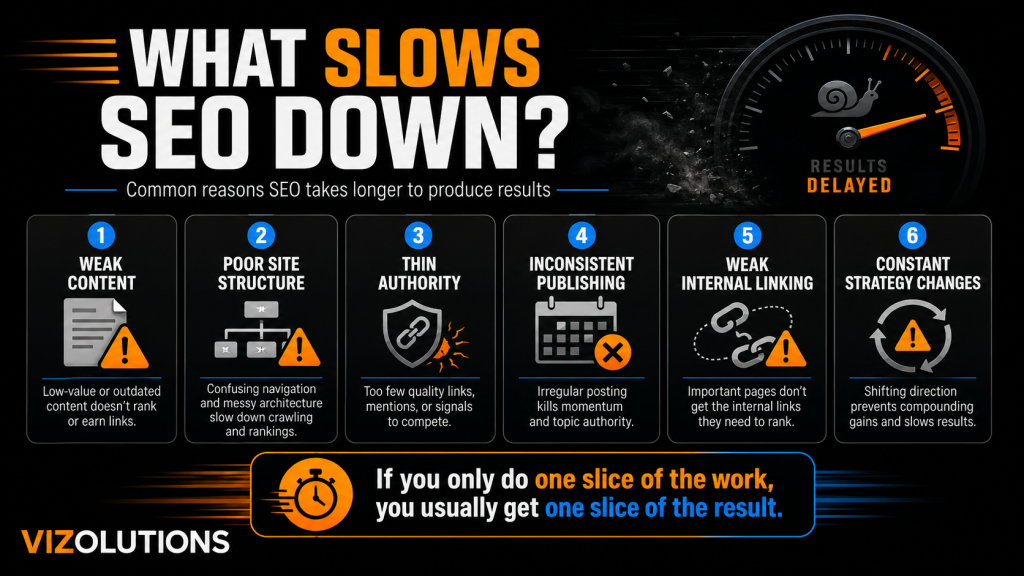
A lot of businesses do not have an SEO patience problem. They have an SEO drag problem.
Things that slow results down:
- weak service pages
- thin content
- inconsistent publishing
- ignoring local profile work
- poor internal linking
- bad site structure
- no authority-building effort
- constantly changing strategy every month
- expecting one round of edits to carry the whole campaign
If you only do one slice of the work, you usually get one slice of the result.
So how long does SEO take to work?
Long enough to annoy you. Short enough to be worth doing.
That is the honest answer.
If you want a cleaner version:
- you may see early signs in the first 1 to 3 months
- you often see more meaningful traction in 3 to 6 months
- stronger competitive gains often take 6 to 12 months
The businesses that do best with SEO are usually not the ones demanding instant miracles. They are the ones willing to build something real and smart enough to recognize progress before it turns into bragging rights.
If you want an SEO strategy that is honest about timelines and serious about results, start with our SEO marketing strategy. If you want to talk through what your timeline is likely to look like based on your market, your site, and your competition, contact Vizolutions and let’s nerd out about it.
FAQs
A realistic range for meaningful movement is often 3 to 6 months, while more competitive markets can take 6 to 12 months for stronger ranking gains. Google also notes that some SEO changes can take several months to be fully reflected in search.
Usually things like more impressions, more indexed pages, wider keyword spread, stronger long-tail visibility, and improved engagement from organic visitors show up before major ranking wins. Google’s crawl and indexing guidance supports the idea that visibility changes happen in stages, not all at once.
Because competition, authority, trust requirements, and content depth vary widely by industry and market. A local service business in a lighter market is simply not fighting the same battle as a law firm or a national brand. This is also why consistent strategy matters more than hoping for a quick spike.